Kip Kissel or Ghip Ghisizzle: what OpenAI's new transcription models actually buy you
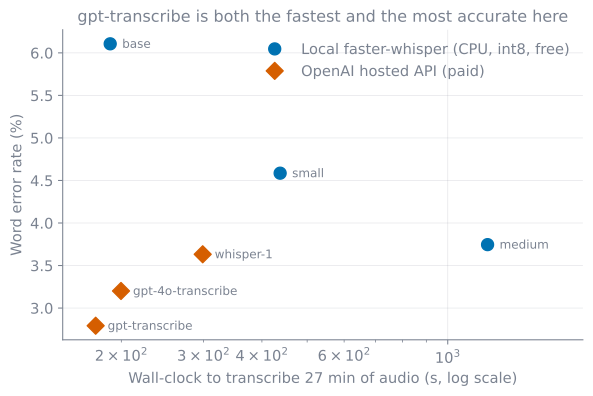
OpenAI’s new gpt-transcribe costs $0.0045 per minute, undercutting the whisper-1 endpoint it replaces. Re-running my own 200-utterance LibriSpeech benchmark, it scored 2.79% word error rate against 3.75% for a local faster-whisper medium, and ran seven times faster in wall-clock. The margin is thinner than it looks: a fifth of all its remaining errors are spelling conventions rather than mishearings. The feature actually worth paying for is keywords, which lets you hand the model your proper nouns up front and took three of my worst utterances straight to zero.
Three weeks ago I published a benchmark of local Whisper model sizes arguing that you don’t need to pay anyone to turn audio into text. Then OpenAI shipped two new transcription models, gpt-transcribe for completed files and gpt-live-transcribe for live streams, and priced the async one below the hosted Whisper endpoint it replaces.
That is the kind of news that should make you re-test a conclusion instead of repeating it. So I pointed the same corpus, on the same laptop, at the new API.
The API won this time. It also taught me something about the metric I was using to judge it.
What actually shipped
Two models for two jobs. gpt-transcribe handles completed audio files and batch work. gpt-live-transcribe handles a live stream where you want text while the person is still talking. The docs are firm that streaming output and live input are separate decisions.
The prices, from OpenAI’s pricing page:
| model | price | per hour of audio |
|---|---|---|
gpt-transcribe |
$0.0045 / min | $0.27 |
gpt-live-transcribe |
$0.017 / min | $1.02 |
whisper-1 (the old endpoint) |
$0.006 / min | $0.36 |
The async model undercuts the Whisper endpoint by 25%. That is the genuinely new economic fact, and it is why the earlier post deserved a re-test rather than a footnote.
OpenAI’s own claim is that gpt-transcribe cuts word error rate from 15.21% to 8.98% on something they call the Real World Audio Benchmark. Read that carefully: their benchmark, their audio, their scoring. Vendor numbers tell you a direction of travel and nothing about your files.
The rematch
Same machine as the original post, a 13th-gen Intel Core i7 with 16 threads, CPU only. Same corpus, 200 utterances drawn deterministically from LibriSpeech test-clean, 27 minutes of audio. Same scoring, jiwer with case- and punctuation-insensitive normalization. Local models run through faster-whisper at int8 and beam_size=1, hosted models get the FLAC uploaded straight to /v1/audio/transcriptions with no context parameters. Every model saw the identical 200 files.
| model | WER | wall-clock | vs realtime |
|---|---|---|---|
base (local) |
6.11% | 189 s | 8.6× |
small (local) |
4.59% | 438 s | 3.7× |
medium (local) |
3.75% | 1217 s | 1.3× |
whisper-1 (hosted) |
3.63% | 299 s | 5.5× |
gpt-4o-transcribe (hosted) |
3.20% | 200 s | 8.2× |
gpt-transcribe (hosted) |
2.79% | 176 s | 9.2× |
gpt-transcribe is the most accurate model in the run and also the fastest, which is not a combination the local tiers ever offer. It beats the best local model I tested by about a quarter, relative, and returns the whole 27 minutes in under three, while medium grinds for twenty. It beats the old whisper-1 endpoint by a similar margin, which is at least consistent with the direction OpenAI advertised.
One process note, because it nearly cost me the post. I ran a 40-utterance pilot first, and it said the opposite: gpt-transcribe tied local medium exactly and lost to the older gpt-4o-transcribe. That pilot covered 856 reference words, so the entire gap between those two models was seven errors. At 200 utterances and 4,405 words the ordering flipped and stayed put. Forty utterances is enough to convince yourself of something wrong.
What the word error rate is actually scoring
A 2.79% error rate reads as “about one word in thirty-six is misheard.” So I dumped all 108 error spans and read every one. Most are not mishearings.
substitute  ref='sombre'      hyp='somber'
substitute  ref='neighbour'   hyp='neighbor'
substitute  ref='inclosed'    hyp='enclosed'
substitute  ref='mister'      hyp='mr'
substitute  ref='two'         hyp='2'
substitute  ref='ante'        hyp='anteroom'     (+ deleted 'room')
substitute  ref='door'        hyp='doorstep'     (+ deleted 'step')
British against American spelling. Archaic against modern. An abbreviation the reference spells out. A digit instead of a word. Compound words the model joined and the transcriptionist split. Of the 108 error spans, 7 are British/American or archaic spelling swaps and 13 are compounds the model closed up, so a fifth of the total is pure orthography before you start counting abbreviations, numerals and names.
My favourite one goes the other way entirely. The reference says timaeus; gpt-transcribe wrote timæus, with the ligature, the way the name is actually set in classical texts. It got marked wrong for knowing more than the ground truth.
None of this means the benchmark is worthless. It means that at this range the metric is substantially measuring house style. When Artificial Analysis puts gpt-transcribe at 3.31% against ElevenLabs Scribe v2 at 2.3% and Gemini 3 Pro at 2.9%, some real capability separates them and some of it is whose spelling conventions the scorer happened to prefer.
Strip the orthography out and the errors that remain have one thing in common. They are names.
The parameter that earns the money
Ghip Ghisizzle, a character from a Baum novel. The Boolooroo, his title. Rodolfo and Leocadia from a Cervantes novella. Fitzooth, Stuteley, La Valliere, Tonnay-Charente. No amount of model scale fixes these, because nothing in the audio tells the model how the name is spelled.
This is what the new context parameters are for, and it is the thing my local pipeline cannot do at all. Alongside the audio you can pass prompt for free-form context, keywords for literal terms that may appear, and languages. So I took the three utterances whose only errors were names and handed the model the names:
resp = client.audio.transcriptions.create(
    model="gpt-transcribe",
    file=fh,
    keywords=["Ghip Ghisizzle", "Boolooroo"],
)
Bare, the model returned “I, Kip Kissel, have been the lawful bularoo of the Blue Country.” With those two keywords: “I, Ghip Ghisizzle, have been the lawful Boolooroo of the Blue Country.” That utterance went from 10.8% to zero.
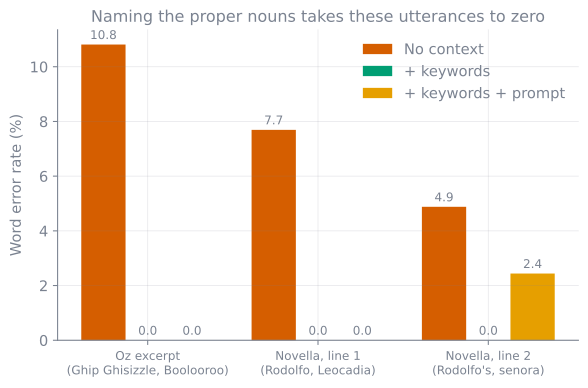
All three went to zero. That is the product. Not a fractional improvement on a leaderboard, but a supported way to tell the model that your speakers are going to say Boolooroo, or your drug names, or your customers’ surnames, or the dozen acronyms your team uses that appear nowhere in any training set.
It cuts both ways, and in a way that rhymes with the spelling finding. On the third utterance I also passed a prompt explaining the passage was a Spanish novella. The model obligingly wrote señora, and the error rate went back up from zero to 2.4%, because the reference spells it senora. Context does not make the model more correct in the abstract. It moves the output toward the conventions you described, which helps only when those are the conventions you are scored against.
The live model, and its sharp edge
gpt-live-transcribe runs over the Realtime WebSocket instead of a plain HTTP POST, and my first attempt died immediately:
Turn detection is not supported for this transcription model.The model segments audio itself, so turn_detection has to be left unset rather than configured. Small thing, ten minutes of my life, and exactly the kind of edge a migration guide exists to smooth.
Once connected I streamed a 13.9-second clip paced at wall-clock speed, the way a microphone would deliver it. First text came back 1.52 seconds in, then 48 incremental deltas as the audio played out. For live captioning that feels right.
Then I ran the same clip again and got different words. Bare, the model transcribed the name as Gip and Sizzle on one run and Skip Giszel on the next. With keywords set, both runs came back byte-identical. If you need output that survives a retry, pinning your vocabulary is worth it for the stability alone, never mind the accuracy.
So should you pay now?
At $0.27 an hour, a two-hour meeting costs 54 cents and comes back before a local medium has finished warming up. For one-off recordings, and for anything full of names, the API is now the sensible default. I did not expect to write that sentence three weeks ago.
Volume changes the arithmetic fast. Ten thousand hours of archive is $2,700 through gpt-transcribe, or nothing at all on a machine you already own that can run overnight for a week. Live transcription is steeper still: gpt-live-transcribe costs nearly four times the async model, so continuous captioning turns into a real line item.
And some audio simply cannot be uploaded. Medical recordings, legal interviews, anything under an NDA. There, local Whisper is not losing a benchmark by one percentage point, it is the only thing on the table. That constraint is why I keep the provider boundary abstracted on the LLM side too, so who processes the data stays a decision rather than an assumption.
Where does that leave the original post? Its core claim survives with an amendment I am happy to make. Free, local, offline transcription is still genuinely good, and a mid-tier local model is within about one error per hundred words of a paid API on clean speech. What changed is that “it costs money” is now a weak objection at small volumes, and that the hosted model can be told what the words are.
If you transcribe anything with guest names, jargon or product names in it, go and read the keywords documentation before you read another benchmark table. The improvement you can actually feel is in there, and it never shows up in the headline number.
References and further reading
- OpenAI transcription guide: the model list and the
prompt/keywords/languagescontext parameters. (Link verified.) - OpenAI API pricing: the per-minute transcription rates quoted above. (Link verified.)
- Realtime transcription guide: the WebSocket session shape used for
gpt-live-transcribe. (Link verified.) - The Decoder on the AA-WER results: third-party error rates against ElevenLabs, Google and Mistral. (Link verified.)
- LibriSpeech ASR corpus: the
test-cleansplit used for the rematch. (Link verified.) - faster-whisper: the local CTranslate2 implementation the pipeline runs on. (Link verified.)
- jiwer: used to compute word error rate with case- and punctuation-insensitive normalization. (Link verified.)
The benchmark harness and the raw results are in the repo alongside the plot scripts, under web/scripts/plots/openai-transcribe-vs-local-whisper/measure/.
Working on something in this space, or hiring for it?
Keep reading
- A local Whisper transcription pipeline: picking the right model sizeYou don't need a paid API to transcribe audio. With faster-whisper, int8 quantization, and a little ffmpeg preprocessing you get offline, free transcription. I benchmarked all five model sizes on CPU against LibriSpeech, and the biggest one didn't win.July 7, 2026
- Mind viruses in multi-agent LLM systems: the memory that persists is the payload that spreadsAn Anthropic-co-authored paper builds self-propagating 'mind viruses' that hop between LLM agents. The infection channel is the persistent memory file I already give my own agents.August 23, 2026
- Rendering my own blog diagrams as code: brand-themed TikZ with LuaLaTeXThe figures in these posts aren't drawn by hand. They're generated by bessaviz, a small TikZ/LuaLaTeX library with my brand palette baked in: version-controlled, regenerable, and dark-mode for free. This post is illustrated with it.August 22, 2026
Get the next update by email
Build-in-public updates and new posts, delivered as a digest. Double opt-in · no spam · unsubscribe anytime · handled by Buttondown.