Pass, fail, or diverged: cross-version regression testing for AI agents
- #python
- #pydantic
- #typer
- #llm-agents
- #testing
- #opentelemetry
- #observability
- #tdd
- #building-in-public
ReplayGate is conversation-level regression testing for multi-turn AI agents. It records a real conversation once (every model call, every tool call) into a deterministic fixture, then replays it offline and checks the properties that span the whole conversation, the ones a single-reply assertion can’t see.
You reword your agent’s system prompt. The replies still look fine. Did the behavior actually change? That question is the reason this update exists.
#3 built the gate: replay a recorded fixture, run a suite of cross-turn invariants over it, and turn a violation into a non-zero exit code. But that gate had a quiet limit. It replayed each fixture against the same agent that recorded it, so the trajectory always matched byte-for-byte and every check ran. That catches a broken agent against a pinned trajectory. It does not answer the prompt-tweak question, which is the whole point of a flight recorder: record a conversation from agent version A, then replay a different candidate B against it and see if your invariants still hold before B ships.
Why a different agent breaks the replay
Recording is content-keyed. A recorded LLM exchange is stored under a sha256 over (model, system, messages, tools), and a tool call matches on its exact (name, args). Replay a candidate that reproduces those calls and every key hits the recording, zero network. Replay a candidate that changes anything upstream (a reworded system prompt, a different model, a tool it decides to call one turn earlier) and it asks for a key that was never recorded.
The old code answered that miss with a bare KeyError. A crash. Not a pass, not a fail, just a stack trace. Deciding what that miss actually means turned out to be the core of the whole feature.
Divergence is a third verdict, not a failure
Here is the fork I had to resolve. A key-miss is not inherently a pass or a fail. It is an orthogonal fact: the candidate left the recorded trajectory. So I made it a first-class outcome instead of an exception. The bare KeyError became a typed DivergenceError(kind, summary) (kind is "llm" or "tool"), and the report grew a Divergence(turn_index, kind, summary) alongside the invariant results it already carried.
That splits into a policy the caller picks, and it’s a genuine tradeoff:
pinned(the default, keeps the zero-network story): a key-miss short-circuits to a DIVERGED outcome. Replay stops at the diverging turn, and invariants past it are reported as not evaluated, because offline I genuinely cannot know what the candidate would have said next. Honest by construction.live: a key-miss falls back to the real provider, records the new exchange, and continues. The invariants then run over the candidate’s actual trajectory. It costs a provider call and credentials, exactly like recording live does.
pinned pins the trajectory, so a behavior-preserving reword still diverges. That is the honest face of content-keying, not a bug. live is the mode for “did the invariants survive a real change.” The two policies land on three real exit codes (plus 2 for a bad or unknown fixture): 0 invariants held, 1 an invariant was violated, 3 diverged under pinned. Code 3 is only reachable under pinned, because live resolves every miss over the network.
run_regress stays a thin orchestrator over the replay engine from #2:
def run_regress(fixture, build_agent, tools, *, policy="pinned", inner_llm=None):
    try:
        replayed = replay_conversation(fixture, build_agent, tools,
                                       policy=policy, inner_llm=inner_llm)
    except DivergenceError as e:
        div = Divergence(turn_index=e.turn_index, kind=e.kind, summary=e.summary)
        return RegressReport(scenario=..., policy=policy, divergences=[div])
    results = check_conversation(replayed, invariants_for(fixture.conversation.scenario))
    return RegressReport(scenario=..., policy=policy, results=results)
The invariants stay keyed on the fixture’s scenario, never the candidate’s. The candidate is being judged against agent A’s contract, not its own.
Three candidates, three verdicts, one recording
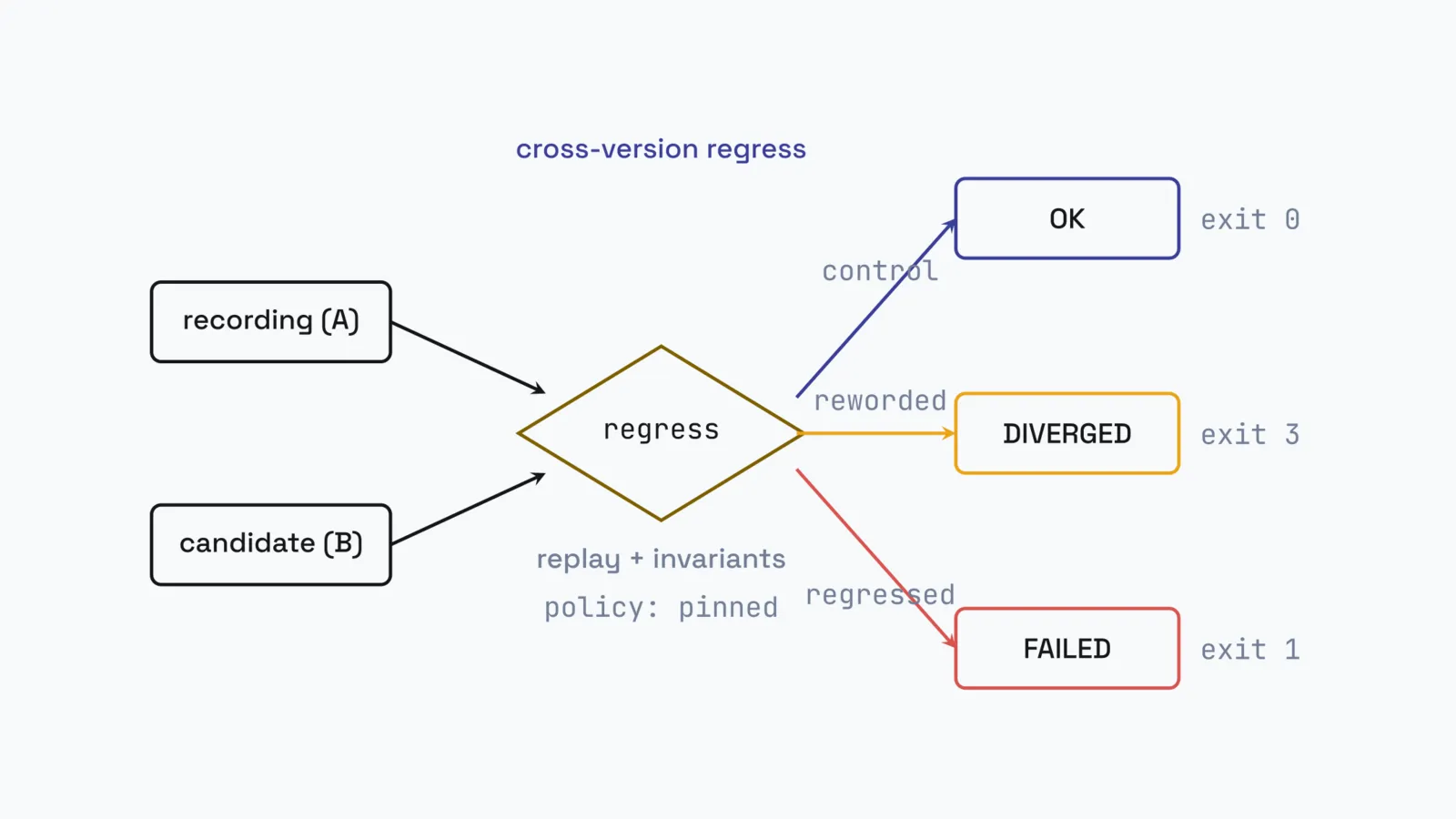
To keep every path real and testable I seeded a small CANDIDATES registry with three variants of the support agent, then recorded one support_happy fixture and ran each candidate against it under pinned:
$ replaygate regress ./fx --candidate support_control
  [PASS] order_id_never_reasked: order id carried forward, never re-asked
regress OK (support_happy): 1 invariant(s) held                 # exit 0

$ replaygate regress ./fx --candidate support_reworded
regress DIVERGED (support_happy): candidate left the recorded trajectory
  - turn 0 [llm]: no recorded LLM response for request_key 2f7872ce4e7e…
  invariants not evaluated (candidate left recorded trajectory)  # exit 3

$ replaygate regress ./fx --candidate support_regressed
  [FAIL] order_id_never_reasked: turn 1: re-asked for an order id already given on turn 0
regress FAILED (support_happy): 1 invariant(s) violated          # exit 1
support_control is the recorded agent itself, so it reproduces every key and the invariant runs. support_reworded behaves identically but ships a different system prompt, so its first LLM call misses on turn 0 and the gate diverges (under --policy live the provider fills that miss, the invariant holds, and it comes back OK). support_regressed re-asks for an order id it was already given: its calls still key into the recording, so it doesn’t diverge, it fails the invariant it violates. Three exit codes, one recording, no mocks.
The bug the live fallback smuggled in
The live path had a subtle defect I’m glad a review caught before it caught me. When a miss falls back to the provider, the new exchange gets appended to the recording so replay can continue. But the recorder was appending to the fixture’s own recording lists, the ones loaded straight off disk. So a single live run quietly mutated the fixture in memory: replay it twice in one process and the second run would find the first run’s live calls already “recorded.” A fixture that changes when you read it is not a fixture. The fix (commit 3b7dfcf) is one line of defensiveness, copy the recording lists before replay so the loaded fixture stays pristine. Shared mutable state handed across a boundary is exactly where these hide.
The spans I’d been deferring since #1
Since #1 every fixture directory has advertised a spans.jsonl file, OpenTelemetry-aligned timing spans, right there in the documented layout. It was a lie of omission: record.py ended with spans=[]. The file was always empty. This update finally makes the capture loop emit them, provider-agnostic, no OpenTelemetry SDK dependency, still fully offline.
A recording is now one trace: a conversation root span, with an llm.create or tool.call child timed around each real call as it happens.
with spans.span("conversation", root_attributes):
    for user_msgs in adapter.user_turns(scenario):
        step = agent.respond(history)   # each llm.create / tool.call nests a child span
Timing comes from an injectable nanosecond clock (real in production, a deterministic counter in tests), so the structure stays testable. Recording booking_happy now writes five real spans (one root, two model calls, two tool calls) carrying GenAI convention attributes like gen_ai.request.model and tool.name. The fixture format finally tells the truth.
What I learned
The useful idea here was refusing a binary. I spent the design stuck on “is a key-miss a pass or a fail,” and both answers were wrong. Naming divergence as a third, orthogonal outcome dissolved the problem: the report carries did it stay on the trajectory separately from did the invariants hold, and the CLI reads a three-way status off that. When two questions keep fighting inside one boolean, the fix is usually a second axis, not a cleverer boolean.
The un-glamorous one: the fixture-mutation bug was invisible in every single-run test, and only bit on a second live replay in the same process. Copying state at a boundary is boring, and boring is what keeps a fixture deterministic.
The suite is 78 tests now, up from 56 in #3, and not one of them imports a provider SDK, reads a key, or opens a socket. Cross-version replay, the divergence policy, and the new spans all run on a laptop with everything unplugged.
What’s next
Two of the three things I promised at the end of #3 are now done: cross-version regress and the deferred spans. That leaves the one I’ve been circling since the start, channel adapters beyond direct, with WhatsApp first, because an agent that’s correct in a unit test can still break on the channel from message ordering or session windows. After that, the surfaces: a semantic judge for the dimensions a deterministic predicate can’t score, and a read-only dashboard that renders the baseline-versus-candidate diff those spans and divergences are already carrying.
Everything above is on main at github.com/bessavagner/replaygate, now cut as v0.1.0 under an MIT license. The question I keep turning over: pinned is honest but noisy (every harmless reword diverges), while live is truthful but spends a real provider call on every run. If you gate agent changes in CI, which would you make the default, and would you ever let a divergence alone fail a build? I’ve built both sides of that switch and I’m still not sure which way it should point by default.
I'm building this in the open, one update at a time.
Keep reading
- The LLM judge that can't fail your build: an offline evaluator, advisory by defaultUpdate 5 of the ReplayGate build log: adding an LLM-as-judge for the dimensions a deterministic predicate can't score (goal completion, relevance, tone), and then spending most of the sprint making sure it can never fail a build on its own. The judge is a real Claude call via forced tool_use, but its verdicts are recorded and replayed offline like every other call, keyed by the conversation and dimensions. `--judge` is advisory (prints scores, never touches the exit code); `--judge-gate` is a separate opt-in with its own exit code 4. Writing the post caught a bug in it: with no recorded verdict the gate found nothing below threshold and passed the build without running, so it now refuses with exit 2 rather than failing open. Plus the golden test that pinned the deterministic gate byte-for-byte before any of this was written, and why I flipped my own roadmap to build the judge before the WhatsApp channel.July 8, 2026
- Caught in the act: a regress gate that fails CI when an agent books before you confirmUpdate 3 of the ReplayGate build log: the record-and-replay from #1 and #2 becomes an actual regression test. A pure-function invariant suite judges a whole replayed conversation (booked-before-confirm, re-asked order id, forgotten dietary constraint), a replaygate regress command turns a violation into an exit code, and a GitHub Actions gate fails the build on a cross-turn bug. Plus the punctuation bug hiding in the flagship invariant's own happy path, and a review finding that made the CI gate honest.July 2, 2026
- Starting ReplayGate: recording an agent before I can replay itUpdate 1 of a new build log. ReplayGate does conversation-level regression testing for multi-turn, channel-native AI agents — it records an agent's LLM and tool calls into a deterministic fixture, then replays them offline to catch the cross-turn bugs (like 'booked before the user confirmed') that per-turn tests miss. This first slice is the record half: the trace contract, a DuckDB span store, the record/replay wrappers, and a CLI — 20 tests, no network.June 30, 2026
Get the next update by email
Build-in-public updates and new posts, delivered as a digest. Double opt-in · no spam · unsubscribe anytime · handled by Buttondown.