One seam, a whole new browser: adding a stealth Firefox to the bench with zero detector changes
- #python
- #playwright
- #camoufox
- #firefox
- #ports-and-adapters
- #hexagonal-architecture
- #protocol
- #browser-automation
- #stealth
- #tdd
- #building-in-public
Which automated-browser setup is actually the stealthiest? People argue about it constantly, usually with vibes. stealthbench is my attempt to replace the argument with a number.
It scores stealth configs (how you set up an automated browser) against open, self-hosted detectors (how a site decides you’re a bot), and commits the result to a file so anyone can rerun it. The whole thing runs offline on your own localhost: no crawler, no login, no target site. It measures detectability, never anyone’s data. A run is the cross-product of configs, detectors and trials, folded into one versioned results file plus a regenerated table and chart.
Until this sprint the fleet was three flavors of the same browser: stock Selenium Chrome, selenium-stealth, and undetected-chromedriver. All Chrome. A benchmark that only tests one engine isn’t measuring stealth, it’s measuring three ways to dress up Chrome. So the job for this update was the first arm that runs a different engine underneath: a stealth Firefox.
The whole point was to not touch the detectors
The new arm is Camoufox, a stealth Firefox that spoofs its fingerprint by default and drives through Playwright’s sync API. That’s a different browser, a different automation SDK, and a different fingerprint surface from everything already in the fleet. The constraint I set myself: add all of it with zero changes to the detector code.
That constraint isn’t discipline for its own sake. It’s the test of an architectural bet I made in the first commits. stealthbench is built on Ports and Adapters (Hexagonal Architecture): the detectors are written against a Protocol, not a real driver. The port is a tiny, driver-agnostic interface called BrowserHandle:
@runtime_checkable
class BrowserHandle(Protocol):
    """Driver-agnostic browser control. `evaluate` runs JS that must `return`."""
    def goto(self, url: str) -> None: ...
    def evaluate(self, script: str) -> Any: ...
    def quit(self) -> None: ...
Every detector speaks only that. It calls handle.evaluate("return window.__TELLS__") and never knows whether a Chrome or a Firefox is on the other end. So a second browser stack should slot in as two new adapters: a PlaywrightHandle that makes a Playwright Page look like a BrowserHandle, and a CamoufoxConfig whose build() launches Camoufox and hands back that handle. If the bet was right, the detectors don’t move.
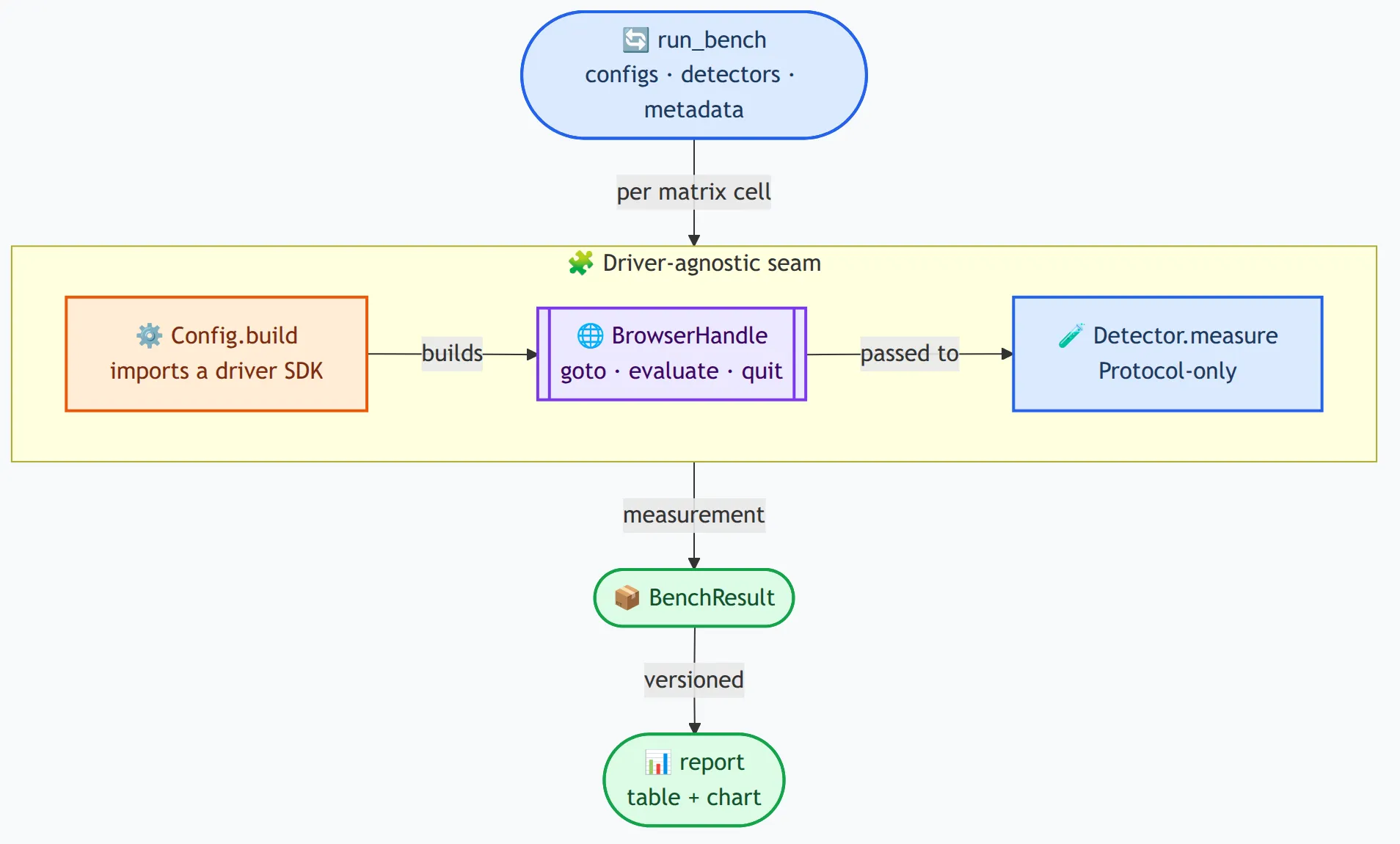
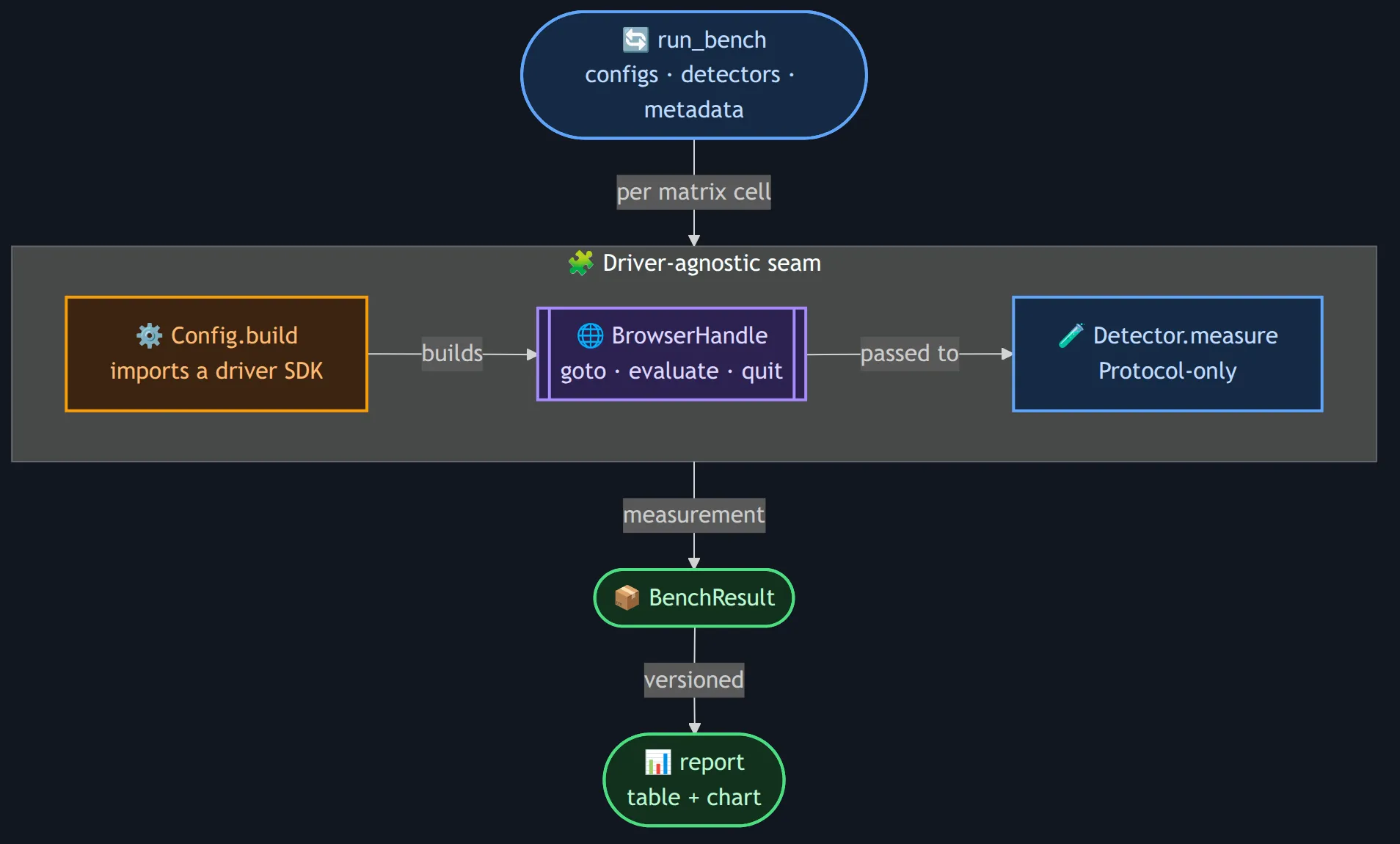
Here’s the whole shape on one page. run_bench walks every config × detector cell; each Config.build (the one side that imports a driver SDK) hands back a BrowserHandle, and every Detector.measure sees only that Protocol. The measurement folds into a versioned BenchResult, then the table and chart.
The adapter that speaks two dialects of “evaluate”
The catch is that Selenium and Playwright disagree about what evaluate means. Detectors were written in Selenium’s dialect: execute_script("return window.__TELLS__"), a statement body that may return. Playwright’s page.evaluate wants an expression or a function instead. The adapter’s job is to translate one into the other so the detectors keep their existing convention untouched.
I expected that translation to be a one-liner: wrap the script as a zero-arg arrow function, () => { return <script> }, let Playwright invoke it. It wasn’t.
Camoufox is Firefox, and page.evaluate runs in Firefox’s content world, where window is an Xray wrapper. Xray is a security feature: it hides “expando” properties that page scripts set, so JS you inject sees a clean, tamper-resistant view of window. Which is a problem here, because the detector pages are page scripts, and everything they report lives on exactly those expando properties. window.__TELLS__ and window.__BOTD__ read back as undefined through the wrapper, even though the DOM is right there and populated. The bench would have recorded a Firefox that “failed” every detector, when really the adapter just couldn’t see the answers.
Firefox exposes the page’s real window at window.wrappedJSObject. So the translation rebinds window to that before running the detector’s script:
def _wrap_script(script: str) -> str:
    return f"() => {{ return (function (window) {{ {script} }})(window.wrappedJSObject || window); }}"
The || window keeps it a no-op on any browser without an Xray wrapper, so the same adapter stays correct if a Chromium-based Playwright arm ever joins the fleet. And because _wrap_script is a pure string function with no browser in it, test_wrap_script_reaches_page_window_past_firefox_xray can prove it against a fake page without ever launching a real Firefox.
I planned for the return-statement mismatch. The Xray wrapper is the one that cost me the afternoon, and it only showed up once a real Camoufox was running.
The proof is an empty diff
The provider seam is a rule: a driver SDK may be imported only under configs/. Nothing in core/, the runner, the report layer, or any detector is allowed to import one. For the browser SDKs this arm introduced, camoufox and playwright, that rule is pinned by a test, so it can’t quietly rot:
def test_no_browser_sdk_import_outside_configs():
    offenders = [...]  # any core/runner/detector file that imports a browser SDK
    assert offenders == [], f"browser SDK imported outside configs/: {offenders}"
And the sprint’s headline proof is a command anyone can run against the merge:
git status --porcelain src/stealthbench/detectors/
# (empty)
A whole new browser engine entered the benchmark and the detector directory shows no changes. A green test that says “the seam holds” is a claim; an empty diff over detectors/ is the receipt.
The honest number
Three detectors score each config: a transparent panel of ~17 automation tells (navigator.webdriver, the $cdc_ properties chromedriver injects, plugin and mimetype counts, and so on), BotD, which returns a verdict and names the kind of bot it thinks you are, and a self-hosted CreepJS, which counts fingerprint inconsistencies it calls lies. I wrote up how these checks work, and how you go about passing them, in Beating browser fingerprinting.
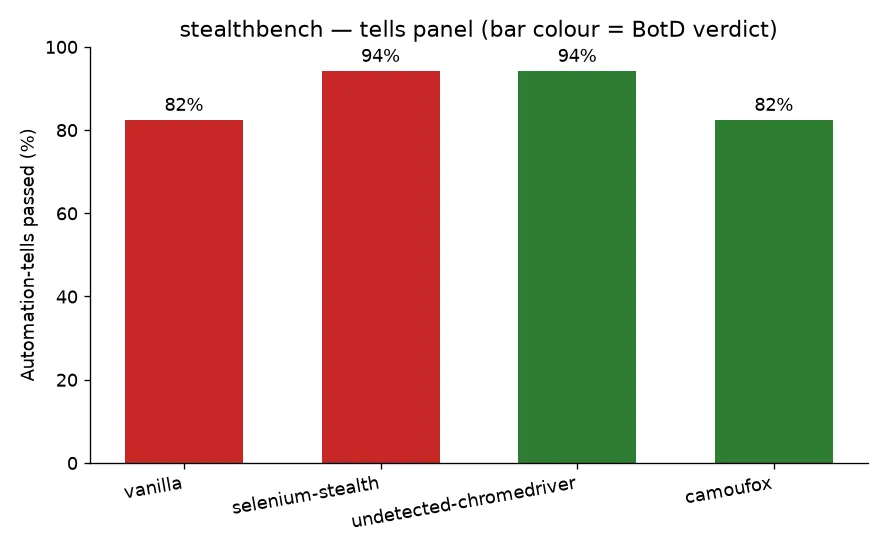
With the arm wired in, the 4-config snapshot I committed at the end of this sprint (Chrome 149 + Camoufox, Linux, 3 trials, results/20260706T214120910749.json) reads:
| Config | Tells passed | BotD | CreepJS lies |
|---|---|---|---|
| vanilla (stock Selenium) | 82% | caught (selenium) | 0 |
| selenium-stealth | 94% | caught (selenium) | 2 |
| undetected-chromedriver | 94% | passed | 0 |
| camoufox (stealth Firefox) | 82% | passed | 0 |
Camoufox passes BotD and CreepJS clean, and it’s tempting to want that 82% on the tells panel to be higher so the new toy looks best in class. But the number is honest and it stays. The three tells it “fails” are all Chrome-specific: window.chrome being present, Chrome’s productSub value, Chrome’s eval.toString().length. A genuine Firefox doesn’t match those because it is genuinely Firefox. Forcing them to pass would mean teaching a Firefox to lie about being Chrome, which is the opposite of what a fingerprint-consistency detector should reward. An 82% that means “this is a real, consistent Firefox” is worth more than a 94% bought by impersonating an engine you’re not running.
The design backs that honesty at the mechanism level too: a detector that errors on the Camoufox arm records an explicit n/a, never a silent pass. If a detector crashes, I want the results file to say so, because a fake pass would inflate the score of whichever config happened to break it.
What I learned
I wrote BrowserHandle in the first week with three Chrome configs behind it, and for a while it looked like ceremony: three adapters that all wrapped the same Selenium. A seam like that only pays you back the day something unlike the others shows up. This sprint was that day, and the whole cost of a second browser engine came out to two new files under configs/, three edits in __main__.py to register it (an import, one more entry in the config list, and " + Camoufox" appended to the run’s browser metadata), and an empty diff over detectors/.
Ports and Adapters gets sold as “swap your database someday,” which is a swap most projects never make. The payoff I actually got is smaller and more useful: when a truly different thing arrived, it arrived as an adapter instead of a rewrite, and the day I added it was boring.
What’s next
The fleet has its first non-Chrome arm; the obvious next moves are more detectors (the panel is deliberately open and self-hosted), and a headful CI workflow so the snapshot regenerates under Xvfb instead of only on my machine. Today CI runs the pure suite with no browser in it, which keeps it fast and keeps the numbers honest about where they came from: my desk.
If you run browser automation, I want the disagreement this benchmark exists to settle: what’s in your stealth setup that you’d bet beats these four, and which detector do you think would catch it first? The repo is open at github.com/bessavagner/stealthbench, every number traces to a committed results/*.json, and adding a config to test your claim is, by design, just one more adapter.
I'm building this in the open, one update at a time.
Keep reading
- A release with no secrets: OIDC trusted publishing, and the tag I didn't pushUpdate 5 of the stealthbench build log. stealthbench scores browser-automation stealth setups against open, self-hosted bot detectors on your own localhost and commits every result. The last story on the roadmap was packaging, and its spec left one thing deliberately unpinned: publish to real PyPI now, or wire the release pipeline against TestPyPI and stop. This update is that decision and what it cost. I aimed the pipeline at TestPyPI, and the reason is visible inside the wheel itself: `python -m zipfile -l` shows the four vendored detector panels ship, but `node_modules/` doesn't, and `botd.html` imports its detector bundle from exactly there. So the wheel carries a detector page and not the bundle that page loads, on top of needing Chrome, Camoufox's patched Firefox, and Node that no Python package can provide. The release itself uses PyPI's OpenID Connect trusted publishing: `id-token: write` lets the job mint a short-lived identity per run and the index verifies which repo, workflow, and environment it came from, so no long-lived API token is stored anywhere. Two console scripts (`stealthbench`, `stealthbench-serve`) give the module invocations from the last two updates real names, and the version went 0.0.1 to 0.1.0. The honest ending: `git tag` returns nothing, so the trigger has never fired, which was a choice. But checking rather than asserting turned up something I hadn't chosen: `gh api .../environments` returns an empty list, so the `testpypi` environment the workflow names doesn't exist, and the pipeline I'd been calling wired is one step short of it. The only build in existence is the one `uv build` made on my laptop in a git-ignored `dist/`.July 31, 2026
- Reproducible in principle, not in practice: one command to run the benchUpdate 4 of the stealthbench build log. stealthbench scores browser-automation stealth setups against self-hosted bot detectors on your own localhost and commits every result. For three updates I'd pitched it as 'anyone can rerun this,' but the actual bring-up was a five-step shell ritual I'd memorized: npm ci and serve the panels on :8901, git clone CreepJS and serve its docs on :8902, then run. This update collapses the four-line server half of that to one command, `python -m stealthbench.serve`, a stdlib-only module (http.server, subprocess, urllib, no new deps) that runs npm ci, fetches CreepJS once, serves both roots, and health-checks each URL until it returns 200 before it says ready. That surfaced a real design question: the whole project rests on 'detectors self-hosted on localhost only,' yet serve does a `git clone` from GitHub. I drew the line at setup versus run time: the fetch is a one-time, idempotent setup step (skipped if the dir exists), and the bench itself still contacts only localhost. The other landed story is `--config`/`--detector` flags to run a subset, built so a bare run is byte-for-byte the old matrix (the no-selection path returns the same list object, identity, so the numbers can't move), a de-selected cell is absent and never a fabricated 0, and an unknown name errors at parse time. The third story, PyPI packaging, I cut.July 22, 2026
- Every falsy value went missing: adding nodriver to the stealth benchUpdate 3 of the stealthbench build log. stealthbench scores browser-automation stealth setups against self-hosted bot detectors on your own localhost and commits every result. This update widens the matrix: two more detectors (a Sannysoft-style panel and rebrowser-bot-detector) and a fifth config, nodriver. nodriver is async and the bench's BrowserHandle contract is sync, so the new handle drives each call to completion on a private event loop. Wiring it in surfaced a real bug: nodriver's tab.evaluate(return_by_value=True) drops falsy results (its unwrap tests `if remote_object.value:`, so 0/false/'' vanish) and leaves plain objects wrapped in a RemoteObject, so detector signals came back as None or garbage. The fix is to stop fighting its unwrap: wrap the script in JSON.stringify and json.loads the returned string, which round-trips every value faithfully. With that fixed, the two new panels mostly corroborate the tells ranking (undetected-chromedriver and nodriver ace both, vanilla and selenium-stealth get dinged), and camoufox runs only 9 of rebrowser's 10 tests because one is Chrome-specific.July 18, 2026
Get the next update by email
Build-in-public updates and new posts, delivered as a digest. Double opt-in · no spam · unsubscribe anytime · handled by Buttondown.