Giving an LLM Agent Memory: Semantic Recall + Working Memory
Ask a fresh language model “how am I doing on spending this month?” and it has nothing to say. It doesn’t know who you are, what you bought last week, or that your dining-out habit has been creeping up since March. Every conversation starts from zero. That’s fine for a one-shot question, but it’s the opposite of what makes an assistant feel like an assistant: the sense that it remembers you.
The fix isn’t a bigger context window (I wrote about the limits of that approach, and what to do instead, in pruning chat context by summarization). It’s giving the agent two different kinds of memory, each doing a job the other can’t. This post is about how those two systems fit together, with real code from an expense-tracking agent built on Mastra.
Why retrieval alone isn’t memory
The reflex when someone says “memory” for an LLM is to reach for retrieval-augmented generation: embed everything the user has ever said, and at query time pull back the most similar chunks. An embedding turns a piece of text into a list of numbers that captures its meaning, so two things that mean the same thing land near each other even when the words differ; a vector store is just a database that searches by that nearness. That idea (retrieve relevant passages and condition generation on them) comes from Lewis et al. (2020), and it’s genuinely powerful. If the user asks “what did I spend at that Italian place?”, embedding-based search will find the transaction even if they never use the word “restaurant.”
But retrieval has a blind spot. It can only return things that were said. It surfaces the past; it doesn’t maintain a state. Ask “what’s my monthly grocery budget?” and retrieval can only help if the user once typed that number into a message that happens to rank well against the query. There’s no place for the agent to decide “this person’s grocery budget is $400” and keep that fact around, updating it as evidence changes.
That’s the split that matters:
- Semantic recall answers “what did we talk about that’s relevant right now?” It’s a search over history.
- Working memory answers “what do I currently know to be true about this user?” It’s a small, structured profile the agent maintains.
You want both, and pairing them is what stops the assistant being generic.
Semantic recall
In Mastra, an open-source TypeScript framework for building AI agents, both systems are configured on a single Memory object attached to the agent. Here’s the real configuration from the expense agent, with storage, a vector store, an embedder, and the recall options:
import { Memory } from '@mastra/memory';
import { LibSQLStore, LibSQLVector } from '@mastra/libsql';

const memory = new Memory({
  // Use the same database for storage and vector store
  storage: new LibSQLStore({ url: env.DATABASE_URL }),
  vector: new LibSQLVector({ url: env.DATABASE_URL }),
  // Use OpenAI embeddings for semantic recall
  embedder: 'openai/text-embedding-3-small',
  options: {
    // Include last 20 messages for conversation history
    lastMessages: 20,
    // Enable semantic recall (RAG) for retrieving relevant past messages
    semanticRecall: {
      topK: 5,                              // 5 most similar messages
      messageRange: { before: 2, after: 2 }, // context around each match
      scope: 'resource',                    // search across all threads
    },
  },
});
A few decisions in there are doing real work:
lastMessages: 20is the cheap, dumb part of memory: the recent conversation, included verbatim. No embeddings, no search; just “here’s what we just said.” Most turns are answered from this alone.semanticRecallis the RAG part. Each incoming message is embedded withtext-embedding-3-small, and thetopK: 5most similar past messages are pulled back from the vector store.messageRangewidens each hit to include the two messages on either side, so a matched line arrives with its surrounding context instead of stranded alone.scope: 'resource'is the one I’d flag hardest. It means recall searches across all of this user’s conversation threads, not just the current one, so a budget the user mentioned in a chat three weeks ago is still findable today. The flip side is thatresourceis the user ID, and getting that scoping right is what keeps one user’s history from leaking into another’s.
That last point is worth a guardrail. The agent never constructs the memory scope inline; it goes through a helper whose entire job is to refuse an empty user ID:
export function createUserScopedMemory(
  userId: string,
  threadId: string = 'default'
): { memory: UserScopedMemoryConfig } {
  if (!userId || typeof userId !== 'string' || userId.trim().length === 0) {
    throw new Error('User ID is required for agent memory isolation');
  }

  return {
    memory: {
      resource: userId, // CRITICAL: this ensures user isolation
      thread: threadId,
    },
  };
}
It’s a small function, but in a multi-user app it’s load-bearing: resource is the isolation boundary for the vector search. A blank or wrong resource doesn’t error out at the database. It quietly searches the wrong person’s embeddings. Failing fast on a missing ID is cheaper than discovering the leak later.
Under the hood, the vector store here is LibSQL (an open-source SQLite fork from Turso), which keeps embeddings in the same database as everything else. For a single-node app that’s a real simplification: no separate vector service to run. If you ever outgrow it, the same shape works with a dedicated extension like sqlite-vec or a managed store; only the vector line changes.
Working memory
Semantic recall is reactive: it fires on a query. Working memory is the opposite: it’s a profile the agent writes to as it goes, and it rides along in context on every turn without a search. In Mastra you enable it on the same Memory object and hand it a Markdown template:
const memory = new Memory({
  // ...storage, vector, embedder as above...
  options: {
    lastMessages: 20,
    semanticRecall: { topK: 5, scope: 'resource' },
    // Persist a profile the agent maintains across conversations
    workingMemory: {
      enabled: true,
      scope: 'resource', // persist across all threads for this user
      template: `# User Profile
- **Name**:
- **Financial Goals**:
- **Preferred Categories**:
- **Transaction Patterns**:
`,
    },
  },
});
The template is the whole trick. It’s not a database schema and it’s not prompt boilerplate. It’s a block of Markdown the agent owns and rewrites over time — the same idea of handing an agent a structured, tagged artifact instead of loose prose that made plans a model can actually execute reliable, just applied to what the agent remembers instead of what it does next. Start it empty, as above, and the fields fill in as the agent learns: the first time the user mentions they’re saving for a house, Financial Goals gets that line; as transactions accumulate, Transaction Patterns might grow to “dines out 3-4×/week, groceries weekly at the same store.”
Two things make this different from just throwing more history at the model:
- It’s curated, not accumulated. The agent decides what’s worth keeping. A hundred coffee purchases collapse into one line (“frequent small coffee transactions”) instead of a hundred rows the model has to re-derive every time.
scope: 'resource'again means the profile follows the user across every conversation. Open a new chat tomorrow and the agent still knows your goals and your categories. That persistence is what makes it feel like memory rather than a session.
Crucially, this is also where the two systems divide labor. Working memory holds the stable facts: name, goals, the shape of normal spending. Semantic recall handles the long tail: that one transaction at the Italian place six months ago that no profile would bother to store. Neither covers for the other.
Normalizing messy input
There’s a wrinkle that memory makes more important, not less: people don’t hand an expense agent clean data. They type “spent 50 on lunch yesterday,” or forward a PDF bank statement, or dictate a voice note on the way out of a store, or photograph a receipt. If each of those flowed into memory in its own shape, the agent’s history would be a mess, and embeddings over inconsistent text recall badly.
So everything is funneled through one normalization step before it touches memory. Audio and documents are converted to text first (Whisper for speech, PDF extraction or OCR for documents — the same family of techniques I wrote about in pulling structured data out of unstructured documents), and then a single parser turns that text into one canonical transaction shape, regardless of where it came from:
export const parseTransactionTool = createTool({
  id: 'parse-transaction',
  description:
    'Parse natural language transaction description into structured data. ' +
    'Extracts amount, description, merchant, date, and payment method.',
  inputSchema: z.object({
    input: z.string().describe('Natural language transaction description'),
    inputType: z
      .enum(['text', 'audio', 'document'])
      .optional()
      .default('text')
      .describe('Type of input'),
    currentDate: z
      .string()
      .optional()
      .describe('Current date in ISO format (YYYY-MM-DD) from system context.'),
  }),
  outputSchema: z.object({
    amount: z.number(),
    description: z.string(),
    merchant: z.string().optional(),
    type: z.enum(['INCOME', 'EXPENSE']),
    date: z.string().optional(),
    paymentMethod: z.enum(['CASH', 'CARD', 'PIX', 'TRANSFER', 'OTHER']).optional(),
    confidence: z.number(),
  }),
  execute: async ({ context }) => {
    // ...prompt the model with the input + current date, parse JSON,
    //    default the date to today, clamp confidence to [0, 1]...
  },
});
The inputType enum is the seam. A voice note becomes audio, a statement becomes document, a chat message stays text. But all three exit the parser as the same outputSchema: an amount, a type, a merchant, a date, a confidence. By the time anything reaches storage or the embedder, the provenance is gone and the shape is uniform. Recall over that history is clean precisely because the messiness was absorbed at the door.
One small detail that turned out to matter: currentDate is passed in explicitly rather than read from the model’s notion of “now.” Models are confidently wrong about today’s date, and “yesterday” is meaningless without an anchor. Feeding the real date in keeps relative dates honest, which matters a lot when you’re later asking memory “what did I spend this month?”
Seeing it personalize
What does all this buy you? Once the agent has a profile and a searchable history, it can do things a stateless assistant simply can’t, like noticing that one category is drifting. The chart below is built from synthetic data (no real user or account), but it shows the kind of pattern working memory is meant to capture: groceries holding steady, transport bouncing around seasonally, and dining-out quietly climbing month over month.
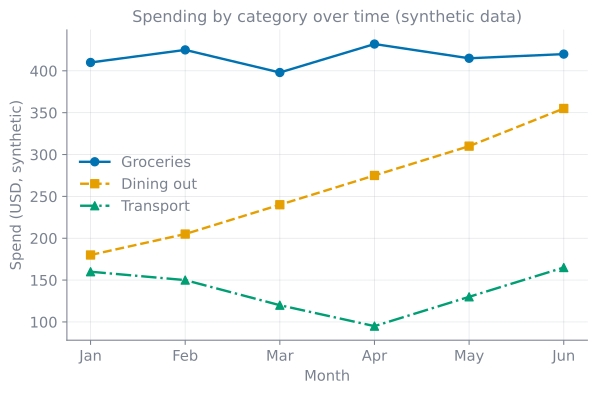
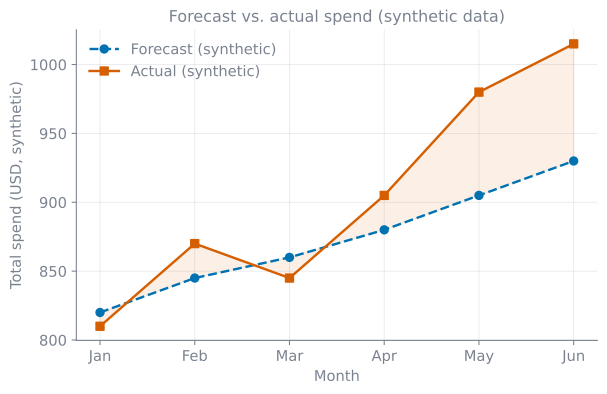
That rising dining-out line is exactly the sort of thing that belongs in Transaction Patterns: not a single transaction, but a trend the agent summarizes and keeps. And once it knows your normal, it can project forward and tell you when reality diverges from it. The next chart (also synthetic) contrasts a forecast the agent might produce from recalled history against what “actually” came in:
The widening gap is the payoff. A generic model can’t draw this chart for you, because it has no idea what your baseline is. An agent that remembers (both the curated profile and the searchable detail behind it) can say “you’re running about $85 over your usual pace this month, mostly on dining out,” and actually be right.
Where I used this
I built this two-memory setup into a personal expense-tracking agent, a Mastra app that ingests transactions from text, voice, PDFs, and photos, normalizes them into one shape, and pairs semantic recall over the full history with a working-memory profile it updates as it learns. The specifics are domain-flavored, but the architecture isn’t: any agent that’s supposed to know a user, rather than just answer a question, wants this same split.
The durable lesson is that “give the agent memory” is really two requests wearing one word. Retrieval gives you reach over everything that was ever said; a maintained profile gives you a stable sense of who the user is. Build only the first and the agent forgets what matters; build only the second and it can’t find the detail. Build both, normalize what flows into them, and the assistant finally starts to feel like it’s paying attention.
References and further reading
- Retrieval-Augmented Generation for Knowledge-Intensive NLP Tasks: Lewis et al., 2020 (NeurIPS), the paper that framed retrieval + generation
- Mastra Memory overview: conversation history, semantic recall, and working memory in one place
- Mastra semantic recall:
topK,messageRange,scope, and embedder/vector-store configuration - Mastra working memory: the persistent Markdown-template profile and resource vs. thread scope
- libSQL: open-source SQLite fork (Turso) used here for both storage and vectors
- sqlite-vec: a small, portable vector-search SQLite extension if you outgrow LibSQL’s built-in vectors
Working on something in this space, or hiring for it?
Keep reading
- Plans an Agent Can Actually ExecuteIf you want a language model to carry out a plan, write the plan for a machine: XML-tagged structure, atomic find/replace edits, patterns defined once, and a verification checklist baked in.July 27, 2026
- Sub-second triage: tiering LLMs for latency-critical pathsI benchmarked a tiered LLM safety gate with 800 real API calls: a fast model on the hot path, a larger one for the cases that need reasoning, plus circuit breakers and a caution-biased fallback. The measurements upended my reasons for tiering. On current models the fast and large tiers run at nearly the same speed, so the real payoffs are cost and, more importantly, catching the emergencies the cheap model quietly gets wrong.July 5, 2026
- Running LLM-Generated Code Without Getting BurnedA practical look at sandboxing the code a language model writes — the threat model, the isolation options, and a minimal Docker setup you can build on.June 23, 2026
Get the next update by email
Build-in-public updates and new posts, delivered as a digest. Double opt-in · no spam · unsubscribe anytime · handled by Buttondown.