Credit-card billing cycles: domain logic and a migration that freezes history
There’s a small, deceptive question at the heart of any expense tracker: which month does this expense belong to? For cash it’s obvious: the month you spent it. For a credit card it is not, and getting it wrong quietly corrupts every monthly total you show the user. This post is about modelling that question properly: as a pure function, applied in exactly one place, with the past protected from any future change to the rule.
The project is a personal-finance tracker I built for my own use. The numbers and screenshots here are synthetic; the code is real.
Purchase date isn’t the bill
When you pay cash, the money leaves your pocket the moment you spend it, so the purchase date is the accounting date. A credit card breaks that link. Every card has a closing date (the last day of its billing cycle, after which new charges roll onto the next statement) and a payment due date a few weeks later. Chase puts it plainly: “The closing date is the last day of your billing cycle… your credit card bill is usually due a few weeks after the closing date” (Chase).
So a single purchase has two relevant dates that can fall in three different months: the day you swiped it, the month its invoice closes, and the month you actually pay. If your card closes on the 20th:
- A purchase on the 5th lands on the invoice closing the 20th of this month, paid next month.
- A purchase on the 27th missed this cycle’s close. It rolls to next month’s invoice, paid the month after that.
If you book expenses by purchase date, that late-month purchase shows up a full two months early in your budget. The fix is to compute the month an expense actually counts toward (what I call its billing month) and store that alongside the raw purchase date.
A pure billing-month function
The temptation is to put this logic on the Entry model, next to the data. I deliberately didn’t. Deciding which month an expense counts toward is an operation that depends on a card’s rules and a date, but it isn’t really owned by any one entity: it’s a calculation. That’s exactly the case Eric Evans describes in Domain-Driven Design: “operations that do not conceptually belong to any object,” which he models as a stateless Service, “an operation offered as an interface that stands alone in the model” (Evans classification, Fowler). It also keeps the rule under a single responsibility, the SRP’s “one, and only one, reason to change” (single-responsibility principle). When the billing rule changes, exactly one function changes.
So it lives in finances/services/billing.py as a free function with no database access at all, just dates in and a date out:
def compute_billing_month(
    entry_date: date,
    payment_type: str,
    closing_day: int | None,
) -> date:
    """Month an expense counts toward."""
    first_of_month = entry_date.replace(day=1)

    if payment_type != PaymentType.CREDIT_CARD or closing_day is None:
        return first_of_month

    if entry_date.day > closing_day:
        invoice_close_month = _next_month(first_of_month)
    else:
        invoice_close_month = first_of_month

    # Invoice is paid the month after it closes.
    return _next_month(invoice_close_month)
Cash, Pix, and any card without a configured closing day count in the purchase month, no surprises. A credit-card purchase on or before the closing day counts one month out (the invoice closes this month, paid next); a purchase after the closing day rolls one further. Because the function takes plain arguments and touches nothing else, it’s trivial to test: feed it a date and a closing day, assert the month. No database, no fixtures, no mocking.
Per-card closing days
Closing days aren’t always constant. A card issuer can shift the date for a single month, and a tracker that ignores that will misfile that month’s purchases. So the closing day passed into the pure function is itself resolved first (a per-month override if one exists, otherwise the card’s default):
def resolve_closing_day(payment_method, entry_date: date) -> int | None:
    """Resolve the closing day applicable to ``entry_date``."""
    month = entry_date.replace(day=1)
    override = payment_method.monthly_closing_days.filter(month=month).first()
    if override is not None:
        return override.closing_day
    return payment_method.closing_day
This is the one piece that does hit the database, and that’s the point of keeping it separate: resolve_closing_day knows about models and queries; compute_billing_month knows only about arithmetic. The query-shaped concern and the rule-shaped concern don’t contaminate each other, and the rule stays unit-testable in isolation.
Applying it once, in save
A computed field is only trustworthy if it’s computed in exactly one place. If three different views each recompute billing_month, they will eventually disagree. So the model’s save is the single choke point. Every write goes through it:
def save(self, *args, **kwargs):
    if not self.billing_month_override:
        self.billing_month = compute_billing_month(
            self.date,
            self.payment_method.type,
            resolve_closing_day(self.payment_method, self.date),
        )
    super().save(*args, **kwargs)
Two things matter here. First, save orchestrates (it resolves the closing day, then calls the pure function) but holds no billing logic of its own. Second, the billing_month_override flag. When it’s set, save leaves billing_month untouched. That flag is how a user can manually pin an expense to a specific month, and, as we’ll see next, how history defends itself against a changing rule.
Freezing history safely
Here’s the failure mode that the override flag exists to prevent. The billing rule above is the current rule. Earlier, the app booked credit-card expenses differently: installment charges, in particular, were entered with the month they were charged, not the purchase month. The day I shipped the new compute_billing_month, every one of those historical entries became a time bomb: the next time any of them was re-saved (an edited description, a re-categorisation), save would recompute billing_month under the new rule and silently move a months-old expense to a different month. Past totals would shift under the user with no audit trail.
The clean fix is not to migrate the data (it’s already correct) but to migrate the flag. A one-shot data migration pins every existing credit-card entry with billing_month_override=True, so save will never recompute them:
def freeze_credit_entries(apps, schema_editor):
    Entry = apps.get_model("finances", "Entry")
    Entry.objects.filter(
        payment_method__type="credit_card", billing_month_override=False
    ).update(billing_month_override=True)


def noop_reverse(apps, schema_editor):
    # Irreversible by design: we cannot tell which entries were already frozen
    # before this migration, and unfreezing would risk silent month changes on
    # the next save. The data itself is untouched, so there is nothing to undo.
    pass
Two design notes worth lingering on. First, apps.get_model("finances", "Entry"), not a direct import. A data migration must use the historical model as it existed at that point in the migration graph, so the code keeps working even after the real model changes later. Second, the reverse function is a deliberate no-op rather than absent. Django’s docs note that if reverse_code is None, “the RunPython operation is irreversible” and unapplying it raises IrreversibleError; passing RunPython.noop instead makes the migration formally reversible “when you want the operation not to do anything in the given direction” (Django migration operations). I chose the explicit no-op because there’s genuinely nothing to undo (the data was never touched) and a docstring that says why beats a silent IrreversibleError for the next person reading migrate --plan. The migration is a piece of documentation as much as a piece of code.
Seeing it on a timeline
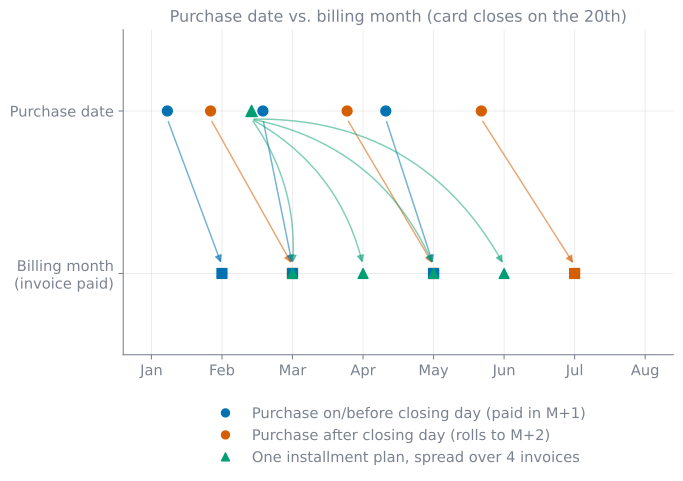
The rule is easiest to believe when you watch it act on real dates. Here are six synthetic one-off purchases across early 2026 on a card that closes on the 20th, plus one installment plan split across four consecutive invoices. The top row is when each was purchased; the bottom row is the month it actually counts toward:
The blue arrows shift one month to the right: purchases that beat the closing day. The orange arrows shift two: purchases that missed it and rolled to the next invoice. The green plan is the interesting one: a single purchase fanning out across four consecutive billing months, each installment landing on the next invoice. Booking any of these by purchase date would scatter them into the wrong months; the billing-month function is what lines them up where the user’s wallet actually feels them.
Where I used this
This runs in the credit-card accounting of my expense tracker. The shape is the part worth keeping: a pure, deterministic function for the rule; a thin resolver for the one stateful lookup it needs; a single save hook so the field is computed in exactly one place; and a freeze migration so that changing the rule tomorrow can’t rewrite what the user already saw. It’s the same front-load-the-structure instinct behind spec-driven scaffolding: decide the shape once, in one place, so nothing downstream has to re-derive it. The domain logic stays testable, the history stays honest, and “which month does this belong to?” has exactly one answer.
References and further reading
- Credit Card Billing Cycles, Explained (Chase): closing date vs. payment due date, the basis of the rule.
- E. Evans, Domain-Driven Design (2003); see Evans Classification (Martin Fowler): Entities, Value Objects, and stateless Services for operations no entity owns.
- Single-responsibility principle: Robert C. Martin’s “one, and only one, reason to change.”
- Django migration operations (RunPython):
reverse_code,RunPython.noop, historical models viaapps.get_model, andIrreversibleError.
Working on something in this space, or hiring for it?
Keep reading
- Typed domain exceptions with stable error codes: the kernel raises a code, the adapter writes the proseAn accounting kernel that must never say a word to a user. Every domain failure gets a typed exception and a stable machine code; one adapter table turns that code into localized prose. Here's the hierarchy, the import cycle it caused, the contract check that reported green through a hole, and the bug I found writing this.August 11, 2026
- Don't let the LLM do the math: deterministic discount proration for receipt OCRA vision model reads the receipt fine, then quietly loses a cent splitting the discount. Here's why I moved the arithmetic out of the model into a small Python function whose shares always sum to the amount paid.August 7, 2026
- Django Channels: database_sync_to_async and the ORM in async consumersThe Django ORM is synchronous; an AsyncWebsocketConsumer is not. database_sync_to_async is the wrapper that bridges them. How Channels' async consumers and channel-layer groups broadcast to every connected client, and where the ORM boundary actually sits.July 13, 2026
Get the next update by email
Build-in-public updates and new posts, delivered as a digest. Double opt-in · no spam · unsubscribe anytime · handled by Buttondown.