Typed domain exceptions with stable error codes: the kernel raises a code, the adapter writes the prose
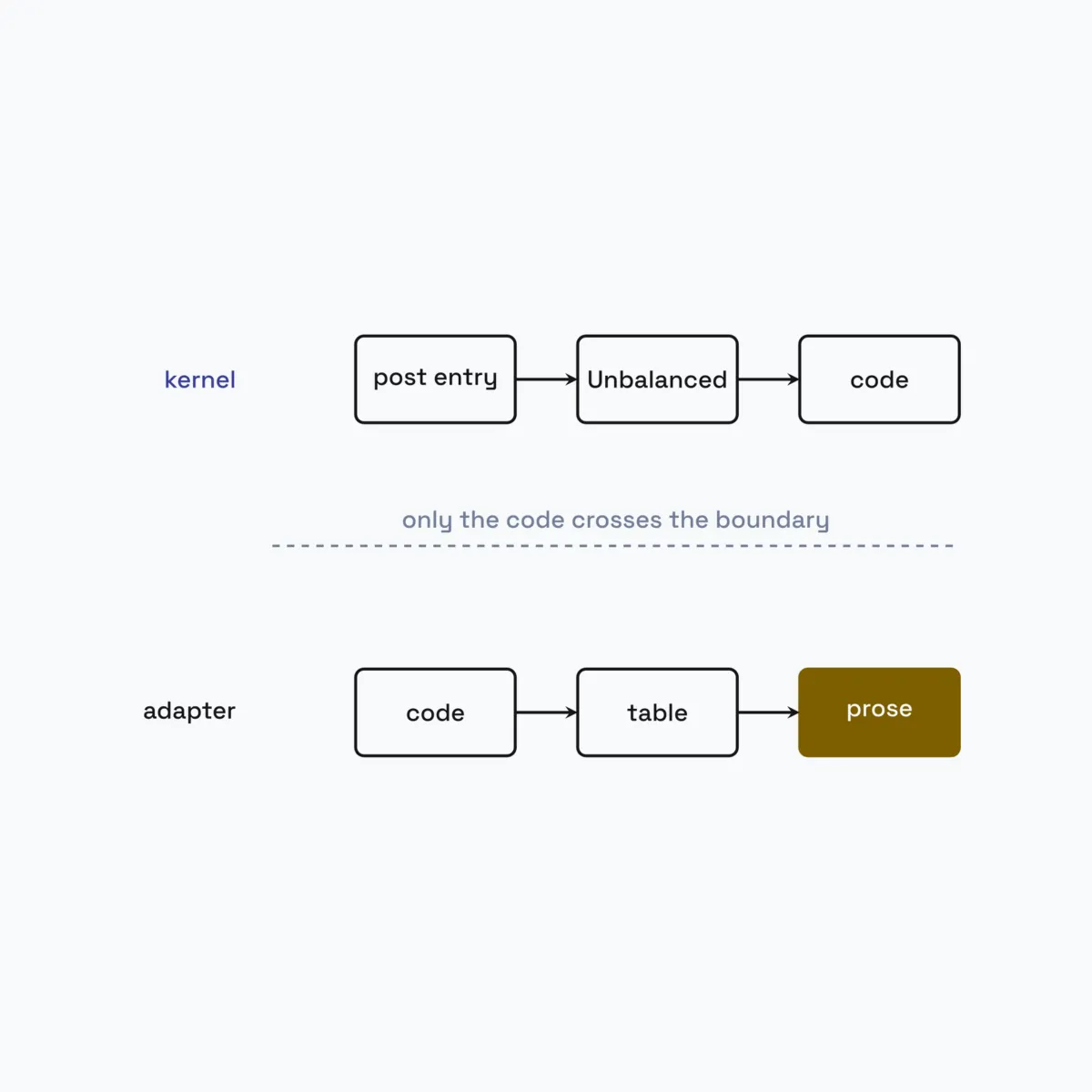
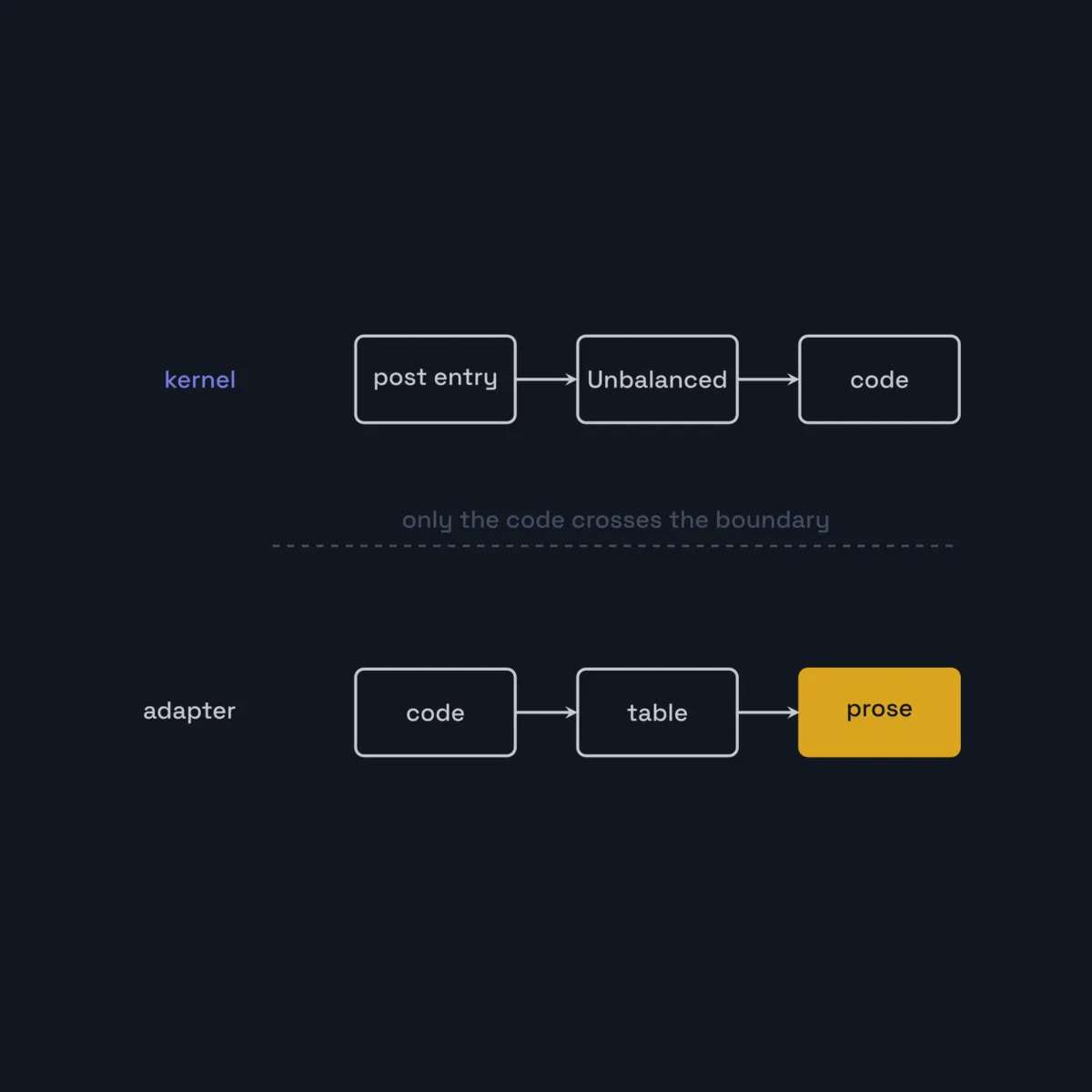
I have a Django app whose accounting core is not allowed to speak Portuguese. Or English. It is not allowed to produce a sentence at all.
The app is a cash-flow kernel: double-entry bookkeeping for a small company’s books, where every expense becomes a journal entry with balanced debit and credit lines. The core of it is a handful of pure service functions (post_entry, reverse_entry, account_balance) that take plain arguments and return plain objects. They touch no HTTP, no templates, no serializers. A test asserts that, by walking the module’s AST and failing if it imports django.http, django.template, django.shortcuts or rest_framework.
That constraint is easy to state and immediately raises a question: when post_entry refuses a lopsided entry, what does the user see?
The kernel raises a typed domain exception carrying a stable machine code, and something further out decides what a human reads. Two things went wrong implementing that, and a third I only found sitting down to write this.
A base class, eight codes, no prose
Here is the whole exception module, minus five sibling classes that follow the identical shape:
class LedgerError(Exception):
    """Base for every ledger domain error. Carries a stable machine code."""

    code = "ledger_error"


class UnbalancedEntry(LedgerError):
    code = "unbalanced_entry"


class AccountNotPostable(LedgerError):
    code = "account_not_postable"


class CrossOrganizationAccess(LedgerError):
    code = "cross_organization_access"
That is the entire mechanism. A base class so any caller can write except LedgerError and catch every domain failure at once, and a class attribute per subclass holding a lowercase snake_case string that never changes.
The exception message is still free to be useful, it is just useful to me:
type      : UnbalancedEntry
isinstance: LedgerError -> True
.code     : 'unbalanced_entry'
str(exc)  : 'debits 100.00 != credits 90.00'
str(exc) is developer detail, headed for a log. .code is the contract. The split matters because those two strings have opposite requirements: the message should say as much as possible about this particular failure, and the code must say the same thing forever so that everything downstream can rely on it.
The pattern has a name worth saying out loud: this is a small error taxonomy behind an anti-corruption layer. The kernel’s vocabulary of failure is finite, enumerated and owned by the kernel; nothing outside gets to invent a new one, and nothing inside gets to leak presentation concerns back in. It is the same instinct as keeping arithmetic out of a language model and in a Python function that always reconciles: put the part that must be exact somewhere it cannot drift.
The adapter owns every sentence
One module maps codes to prose, and it lives in the presentation layer:
_CODE_MESSAGES = {
    "unbalanced_entry": _("This entry does not balance."),
    "account_not_postable": _("That account cannot receive postings."),
    "entry_already_reversed": _("This entry was already reversed."),
    "cross_organization_access": _("That record belongs to another organization."),
    "account_not_found": _("No account matches that category."),
    "party_not_found": _("No such payer."),
    "party_has_no_control_account": _("This payer has no control account yet."),
    "entry_not_found": _("No such entry."),
}


def message_for_code(code: str) -> str:
    return _CODE_MESSAGES.get(code, _("Something went wrong."))
Every view that touches the kernel does the same three lines: catch LedgerError, call message_for_code(exc.code), render. The machine code never reaches the page, which one of the view tests asserts directly by checking that the body contains the localized sentence and not the string account_not_found.
The reason this is a table and not a message on the exception is the _() wrapping each value. The app ships two languages, English as the source and Brazilian Portuguese as the default, so the same unbalanced_entry has to come out as either “This entry does not balance.” or “Este lançamento não está balanceado.” depending on who is asking. There is no sentence you can put on UnbalancedEntry that satisfies both. The code is the thing that is language-independent, so the code is the thing that crosses the boundary.
The fallback in message_for_code is the other half of the deal. An unknown code renders “Something went wrong.” rather than raising, so adding a ninth exception class can degrade a message but cannot 500 a page.
Making the codes a contract instead of a convention
A stable code is only stable if something notices when it moves. Two tests do that.
The first pins the set. It imports all eight classes and asserts that the collected codes equal a hard-coded set of eight literal strings, then asserts the set has exactly 8 members so no two classes can quietly collide on one code. Renaming unbalanced_entry now requires editing the test that says it is called unbalanced_entry, which is the point: the rename becomes a decision instead of a side effect.
The second lives over in the feature module and walks all eight exception classes, asserting each one’s .code is a key in _CODE_MESSAGES, deliberately testing membership rather than the lookup, so a class that lost its message fails here instead of quietly surfacing the generic “Something went wrong.” in front of a user.
That is the unglamorous half of “stable error code”: the adjective does no work unless a test enforces it.
The cycle underneath
The exceptions did not start where they are now. They started inside the kernel’s public seam, ledger/public/exceptions.py, and the services imported them from there. That reads correctly and it was wrong.
Importing ledger.public.exceptions initialises its parent package, and ledger/public/__init__.py imports back from ledger.services to re-export the service functions. So a process that imports ledger.services first hits this:
File "src/backend/ledger/services/__init__.py", line 3, in <module>
    from ledger.services.balances import account_balance, ...
File "src/backend/ledger/services/balances.py", line 10, in <module>
    from ledger.public.exceptions import CrossOrganizationAccess, ...
File "src/backend/ledger/public/__init__.py", line 14, in <module>
    from ledger.services import (
ImportError: cannot import name 'EntryView' from partially initialized module
'ledger.services' (most likely due to a circular import)
I reproduced that traceback for this post by reverting the four service modules to their old import line and running a fresh interpreter. It takes about two seconds to trigger and it never once fired in the test suite, because pytest collects files alphabetically and something earlier in the alphabet always imported ledger.public first, warming the package before any service module asked for it. The cycle was real the whole time and the suite’s file ordering hid it.
The classes moved down to ledger/exceptions.py, a plain top-level module below the seam. Services import from there, which pulls in only the empty ledger package. The seam kept a shim that re-exports the same nine names (the base class and its eight subclasses) from ledger.public.exceptions, so not a single external import statement changed. Then a test pinned it, by running import ledger.services in a genuinely fresh subprocess rather than trusting the in-process module cache.
I wrote that down as an architecture decision record, because the tempting alternatives are both traps. Reordering imports or moving them inside functions hides the cycle behind a rule nobody will remember, and a future revert reopens it in silence. Merging the exceptions into the seam’s __init__ couples the error surface to service initialisation, which is the coupling that caused the bug.
The contract that reported green through the hole
Moving the classes below the seam opened something I did not anticipate.
The repo enforces its module boundaries with import-linter: a contract in pyproject.toml says the expenses feature module may not import a list of kernel internals. That list named ledger.models and ledger.services, which was complete when the typed errors existed only under ledger/public/. After the move, ledger.exceptions was a new, unlisted, importable path straight past the seam.
I put the bypass in on purpose to see what the tooling would say. One import of ledger.exceptions added to a file under expenses/, and:
kernel imports no feature module KEPT
ledger service layer excludes presentation frameworks KEPT
modules use only the public seams KEPT

Contracts: 3 kept, 0 broken.
Three kept, zero broken, while a feature module reached below the seam in the same run. The check was not lying. It was answering the question it had been asked, and the question no longer covered the codebase. That is the same shape as a tenant-isolation test that passes because it runs as a superuser: green, and evidence of nothing.
Adding ledger.exceptions to the contract closes it. The interesting part is what happened next. Once the module is forbidden and no file imports it, deleting it from the contract again puts the suite right back to green, because there is no violation left for the rule to catch. The guard was unfalsifiable: I could delete the fix and nothing would tell me.
So the guard got a guard. One test reads pyproject.toml, selects the contract by name rather than by index, and asserts that ledger.exceptions appears in its forbidden_modules and in the AST scan’s own tuple, and that the two sets are equal. Delete either half now:
E  AssertionError: ADR-0012 moved the typed errors below the seam;
   expenses must not reach them
E  assert 'ledger.exceptions' in ['core.models', 'core.views',
   'ledger.models', 'ledger.services']
Selecting by name matters more than it looks. An index would silently point at a different contract the day someone reorders the file, and the test would keep passing while checking the wrong thing. The same instinct as writing plans against a schema rather than a position in a document: name the thing you mean. There is a longer version of this argument in the build log for another project, where the import boundary broke the first time a module actually used it.
What I found writing this post
While assembling the code-to-message examples above, I ran message_for_code("unbalanced_entry") under an English locale and got Portuguese back.
The adapter imports gettext as _, and _CODE_MESSAGES is a module-level dict literal. So every value is translated once, when the module is first imported, under whatever language happened to be active in that worker process. The dict holds eight plain str objects. Switching the active language afterwards changes nothing.
The app has LocaleMiddleware installed and lists both languages, so this is reachable. A request with Accept-Language: en down the error path returns:
Content-Language header : en
body contains 'Nenhuma conta corresponde': True
body contains 'No account matches that category.': False
A response that declares itself English and carries a Portuguese error message. Django’s answer is gettext_lazy, which returns a proxy that resolves at render time instead of import time; the same eight strings then follow the active language correctly.
It is unfixed as I write this, and it is a good argument for the design rather than against it. The bug lives entirely in the prose layer. Every .code was correct in every one of those runs, the taxonomy held, and the fix is one import and eight unchanged dictionary keys. Had the sentences lived on the exception classes, the same mistake would have been a change to the kernel.
What I would keep
A domain error is two values: a message for me and a code for everything else. Conflating them is how a frontend ends up matching on prose that a translator will change next week. Give the code a test that spells it out in literals.
Where the exception classes physically live is an architecture question rather than a filing one. Putting them in the seam looked tidy and created a cycle that only stayed hidden because of alphabetical luck.
And a boundary check reports on the rule you wrote, not on the boundary you meant. When I closed a bypass, the closing was itself deletable without consequence until a test asserted the rule by name.
The obvious next place for this is a JSON API: the code goes in the response body, the message stays a rendering concern, and the client switches on the code. I have not done it. My other Django project, the polymorphic vault API, answers a bad request with {"detail": "url is required"} and nothing else, which is precisely the untyped string I have spent this whole post arguing against. It has one shared endpoint serving many shapes, so its failures ought to be as uniform as its successes. That one is on the list.
The gettext bug is the one I keep thinking about. It is reachable in production and the fix is one import, because the taxonomy had decided months earlier which layer was allowed to hold a sentence. That is the return on the pattern: it settles where a mistake like that can land.
Want the full background behind work like this?
Keep reading
- Credit-card billing cycles: domain logic and a migration that freezes historyThe day you swipe a card is not the month you're accounting for. Here's how I modelled credit-card billing cycles as a pure function, applied it in one save hook, and used an irreversible migration to stop a future rule change from rewriting the past.July 25, 2026
- One flexible API for many shapes: polymorphic vaults in Django REST FrameworkStoring recipes, bookmarks, journals and groceries behind a single REST surface: a polymorphic Item base, dynamically composed nested serializers, atomic multi-table writes, and the eager-loading that kills the N+1 queries.July 9, 2026
- An API-first vault my agents can call: designing a DRF backend for MCP-style consumersI built a vault so a skill or an agent could store structured items without me rewriting the domain each time. That meant designing the DRF API for a non-human caller: stable UUIDs, an open metadata field, and a discoverable OpenAPI schema. Then I probed it for idempotency and found I never built any.August 18, 2026
Get the next update by email
Build-in-public updates and new posts, delivered as a digest. Double opt-in · no spam · unsubscribe anytime · handled by Buttondown.