Getting scheduled jobs right: idempotent monthly resets with Celery Beat
Every subscription product eventually needs the same thing: on the first of the month, give every user their allowance back. Reset the question quota, refill the page credits, zero the counters. It reads like a one-line cron job: fire a task on the 1st, loop over users, set the numbers back to the plan defaults.
I built exactly that for a SaaS chatbot product, and the one-liner was a trap. The reset itself is easy. The trap is that “fire a task once a month” is a promise a distributed system can’t keep. The schedule will sometimes fire twice. The clock will sometimes be wrong. The worker will sometimes die halfway through the loop. The interesting engineering is in making the reset survive all of that, and the answer turns out to be idempotency: write the task so that running it twice does the same thing as running it once.
“Just run it on the 1st”
The naive version puts the date logic in the schedule. Celery Beat is the piece that “kicks off tasks at regular intervals, that are then executed by available worker nodes in the cluster” (Celery docs), and its crontab schedule can target the first of the month directly:
from celery.schedules import crontab

app.conf.beat_schedule = {
    "monthly-reset": {
        "task": "accounts.tasks.restore_users_quota",
        "schedule": crontab(minute=0, hour=0, day_of_month=1),
    },
}
Tidy. It also quietly bets the entire correctness of your billing on the scheduler firing exactly once, at exactly the right instant, forever. That bet loses. Beat itself warns, in plain language, that “you have to ensure only a single scheduler is running for a schedule at a time, otherwise you’d end up with duplicate tasks” (periodic-tasks docs). During a deploy, a failover, or a misconfigured container, two beats do sometimes run at once. Lean on the schedule for correctness and a double-fire means every user gets their quota reset twice. If the reset were additive, that’s free money you didn’t mean to give away.
So I moved the date logic out of the schedule and into the task. Beat runs the task every day; the task decides whether today is actually a reset day. That sounds wasteful, but it’s the move that makes everything else robust: the schedule becomes a cheap heartbeat, and the task owns the truth.
app.conf.beat_schedule = {
    "daily": {
        "task": "accounts.tasks.restore_users_quota",
        "schedule": crontab(minute=0, hour=0),  # every midnight
    },
}
Month math that doesn’t drift
The first thing the task needs is a correct notion of “a month later.” This is where naive arithmetic quietly breaks. There is no fixed number of days in a month, so today + timedelta(days=30) drifts and today.replace(month=today.month + 1) blows up in December and on the 31st. The boundary cases (January 31st, leap-year February 29th) are exactly the dates a quota system will eventually hit.
dateutil’s relativedelta exists for precisely this. Adding a month with it “will never cross the month boundary”: if the target month is shorter, it clamps to the last valid day rather than producing an invalid date (dateutil docs). January 31 + 1 month is February 28, not an exception. That single guarantee is why the task can reason about “one month after the last reset” without a pile of special cases:
from datetime import datetime
from dateutil.relativedelta import relativedelta
from celery import shared_task

from .models import UserQuota


@shared_task
def restore_users_quota():
    instances = UserQuota.objects.all()
    today = datetime.today().date()
    for instance in instances:
        last_restored_at = instance.restored_at
        one_month_later = last_restored_at + relativedelta(months=1)
        if today == one_month_later or today.month > one_month_later.month:
            instance.restore_values()
The condition reads off each user’s own restored_at and asks whether a month has elapsed since their last reset. It also has a bug in it, which I did not notice until I sat down to write this post. More on that below. The reset day is per-user, anchored to when they last got refilled, which also sidesteps the thundering herd of refilling everyone at the same midnight. @shared_task is Celery’s way of defining a task that isn’t bound to a specific app instance, so it can live in a reusable Django app.
At-least-once means run-twice
Here’s the part that catches people. Even with a single, correctly-scheduled beat, Celery does not promise your task runs exactly once. It can’t: exactly-once delivery isn’t something a message broker hands you for free.
By default Celery acknowledges a task message before it runs, “so that a task invocation that already started is never executed again.” Flip on acks_late and the trade-off reverses: the message is acknowledged only after the task finishes, which is safer against lost work but means “the task may be executed multiple times should the worker crash in the middle of execution.” Either way the docs are blunt about the consequence: “ideally task functions should be idempotent” (Celery task docs). A message isn’t removed from the queue until acknowledged, and a worker that dies after reserving it will see it “redelivered to another worker.”
This is the general shape of at-least-once delivery, and it’s not a Celery quirk. Martin Kleppmann’s Designing Data-Intensive Applications frames it as the standard situation in distributed messaging: you build on at-least-once delivery and recover exactly-once effects by making the operation idempotent, because no single component hands you exactly-once for free (DDIA). The duplicate isn’t a bug to stamp out; it’s a property of the medium to design around.
So I stopped trying to guarantee the task runs once and instead made it not matter how many times it runs.
Idempotency via state
The idempotency here comes from the data the task already owns: restored_at, the date a user’s quota was last refilled. No dedup table, no distributed lock. The reset advances that date, and the guard reads it. So a second run on the same day finds restored_at already set to today, computes one_month_later as a month in the future, and the condition is false. The second run is a no-op because there’s nothing left to do.
The state lives on the model, and so does the reset:
class UserQuota(models.Model):
    # ... per-plan quota fields ...
    restored_at = models.DateField(
        default=datetime.today,
        verbose_name=_("last time quotas were restored"),
    )

    def restore_values(self):
        profile_type = self.user_profile().type
        self.pages = pages_quota_dict[profile_type]
        self.questions = questions_quota_dict[profile_type]
        self.questions_gpt4 = questions_quota_gtp4_dict[profile_type]
        self.documents = documents_quota_dict[profile_type]
        self.context_max_length = context_max_length_dict[profile_type]
        self.restored_at = datetime.today().date()   # advance the guard
        self.save()
The metered fields are the plan’s whole product surface: pages, questions, documents, and context_max_length, the per-plan ceiling on conversation history that makes pruning a long chat by summarization worth doing in the first place.
Two things make this work. First, the reset is a set, not an increment: self.questions = quota_for_plan rather than self.questions += quota_for_plan. Setting to an absolute value is naturally idempotent; running it twice lands on the same number. Incrementing would hand a double-fire straight to the user as a doubled allowance. Second, restore_values writes restored_at = today in the same save, so the guard that gated the call is immediately closed behind it. That single-save discipline is the same instinct as wrapping a multi-table write in one atomic block: the state a later reader depends on has to land with the change that earned it. State-checked idempotency is the cheap, durable pattern DDIA recommends when the broker only gives you at-least-once: re-running converges on the same state instead of compounding.
A caveat about this particular implementation. Reading restored_at and later writing it is a read-then-write, so two workers racing on the same user in the same second could both pass the guard before either saves. In practice a single daily beat makes that vanishingly unlikely, and the fix when it matters is a row lock (select_for_update) or a conditional update that only writes rows where restored_at is still the old value. The set-not-increment shape keeps even a lost race merely redundant.
The bug I found writing this post
I went to explain that guard line by line and couldn’t. Read it again:
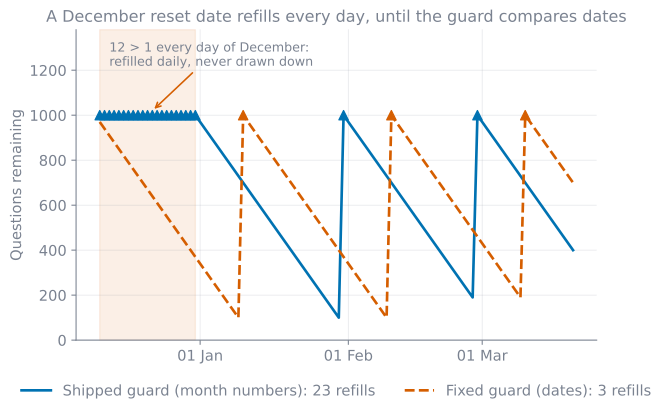
if today == one_month_later or today.month > one_month_later.month:The second clause is there to catch a missed day: if beat was down on the due date, a later run should still refill. But it compares month numbers, and December breaks that. A user whose restored_at is December 10th has one_month_later in January, so one_month_later.month is 1 while today.month is 12, and 12 > 1 is true on every remaining day of the year.
So I ran a daily beat against both versions of the guard over the same calendar. The firing days below are computed from the two expressions, not drawn by hand:
Twenty-three refills against three. Anyone whose reset date lands in December is pinned at the cap until January, and never draws down the allowance they paid for. The clause also fails at the job it was written for: a June user whose due date is missed waits until the 1st of the next month, the first day the month numbers cross.
The fix is the comparison itself:
if today >= one_month_later:
    instance.restore_values()
Dates compare correctly across a year boundary, and a run three days late still refills. relativedelta was already doing the hard part; I was asking it the wrong question.
Two things about how this survived in production. The tests were green because they build their fixed dates from the real datetime.today(), so the December path only runs if you happen to run the suite in December. And the blast radius was bounded by the shape of the reset: because restore_values sets the quota rather than incrementing it, a wrongly-timed run handed a user their allowance early instead of corrupting the number. The idempotency held. The due-date logic is what broke.
Where I used this
This was the quota-reset path in a SaaS chatbot I ran on Django and Celery. The schedule was a daily midnight heartbeat; the per-user restored_at guard and the set-not-increment reset are what kept it correct under duplicate deliveries and restarts. The lesson generalizes beyond quotas: any recurring job that mutates shared state wants the same treatment, whether it sends monthly invoices, expires trials, rolls up usage, or builds the unattended daily digest behind RegWatch. Assume the scheduler will sometimes fire twice, push the “should this happen now?” decision into the task, key it on state you already store, and make the mutation idempotent. Then a duplicate is a shrug instead of an incident.
References and further reading
- Celery: Periodic Tasks: Beat scheduling,
crontabschedules, and the warning to run only one scheduler to avoid duplicate tasks. - Celery: Tasks: default vs.
acks_lateacknowledgement, redelivery on worker crash, and the recommendation that tasks be idempotent. - dateutil: relativedelta: month arithmetic that never crosses a month boundary and clamps to the last valid day.
- M. Kleppmann, Designing Data-Intensive Applications (O’Reilly): at-least-once delivery and recovering exactly-once effects through idempotence.
- Celery: first steps with Django: defining app-independent tasks with
@shared_taskin a reusable Django app.
Working on something in this space, or hiring for it?
Keep reading
- Rendering my own blog diagrams as code: brand-themed TikZ with LuaLaTeXThe figures in these posts aren't drawn by hand. They're generated by bessaviz, a small TikZ/LuaLaTeX library with my brand palette baked in: version-controlled, regenerable, and dark-mode for free. This post is illustrated with it.August 22, 2026
- The cheaper model that cost 51% more: what my eval harness caughtGPT-5.6-terra lists 20% below GPT-5.4 on both input and output. I swapped my expense tracker's default to it on that basis, then measured it against real receipts: it cost 51% more per receipt, and it would have returned HTTP 400 on every single photo.August 17, 2026
- Typed domain exceptions with stable error codes: the kernel raises a code, the adapter writes the proseAn accounting kernel that must never say a word to a user. Every domain failure gets a typed exception and a stable machine code; one adapter table turns that code into localized prose. Here's the hierarchy, the import cycle it caused, the contract check that reported green through a hole, and the bug I found writing this.August 11, 2026
Get the next update by email
Build-in-public updates and new posts, delivered as a digest. Double opt-in · no spam · unsubscribe anytime · handled by Buttondown.