One flexible API for many shapes: polymorphic vaults in Django REST Framework
I keep a personal “vault”: a single app where I dump anything worth keeping: recipes, bookmarks, GitHub repos I want to remember, grocery lists, half-formed project ideas, journal entries, trips, expenses. The interesting thing about that list is that the items have almost nothing in common. A recipe has servings and ordered steps and a bag of ingredients; a bookmark is basically a URL and a title; a grocery list is a checklist. They’re different shapes.
The naive way to build the backend for that is one model and one endpoint per shape: /recipes/, /bookmarks/, /journals/, /groceries/, and so on. It works, and then it doesn’t. Every shared feature (tags, search, favorites, attachments, “show me everything from last week”) has to be reimplemented on every endpoint, and a unified timeline becomes a fan-out across a dozen URLs. This post is about the alternative I actually used: a single polymorphic Item base with typed extensions, one REST surface, and the two things you must get right to make it production-grade: atomic nested writes and killing the N+1 queries.
The “endpoint per type” trap
When you have heterogeneous things to store, there are three classic moves, and two of them are traps.
The first trap is a table per type with no shared base. Every cross-cutting concern (tagging, full-text search, “favorite”, soft-delete, an activity feed) gets copied into every table and every serializer. Adding a new shape means touching all of that shared plumbing again. The shapes diverge, but so does everything they were supposed to share.
The second trap is the opposite overcorrection: one wide table with a pile of nullable columns, or its cousin, the Entity-Attribute-Value (EAV) model: a generic (entity, attribute, value) table where every property is a row. EAV looks infinitely flexible, which is exactly why it’s a well-documented anti-pattern: Bill Karwin catalogues it in SQL Antipatterns under logical-design mistakes. You lose the things a relational database is for: you can’t put a NOT NULL or a foreign-key constraint on a value that’s stored as a string in a shared column, the database can’t type-check anything, and even simple queries turn into self-joins. Flexibility bought by throwing away integrity is a bad trade.
The move that works is the middle path: a shared base model carrying everything the shapes have in common, plus a small typed extension per shape that holds only what’s special. One endpoint, real columns, real constraints — the same bet I made hiding four different LLM providers behind one interface instead of branching on which one was live.
A polymorphic base
Here’s the base. Item owns every cross-cutting field, and a kind enum records which shape a given row is. I’m using Django’s TextChoices so the allowed kinds live in one place, in code:
class Item(models.Model):
    class Kind(models.TextChoices):
        RECIPE = "RECIPE", "Recipe"
        GROCERY = "GROCERY", "Grocery"
        BOOKMARK = "BOOKMARK", "Bookmark"
        GITHUB_REPO = "GITHUB_REPO", "GitHub Repo"
        WEBSITE = "WEBSITE", "Website"
        JOURNAL = "JOURNAL", "Journal"
        # ... trips, expenses, project ideas, other
        OTHER = "OTHER", "Other"

    id = models.UUIDField(primary_key=True, default=uuid.uuid4, editable=False)
    owner = models.ForeignKey(settings.AUTH_USER_MODEL, on_delete=models.CASCADE,
                              related_name="vault_items")
    kind = models.CharField(max_length=32, choices=Kind.choices, default=Kind.OTHER)
    title = models.CharField(max_length=255)
    summary = models.TextField(blank=True)
    content = models.TextField(blank=True)
    url = models.URLField(blank=True)
    tags = models.ManyToManyField(Tag, related_name="items", blank=True)
    metadata = models.JSONField(default=dict, blank=True)
    is_favorite = models.BooleanField(default=False)
    created_at = models.DateTimeField(auto_now_add=True)
    updated_at = models.DateTimeField(auto_now=True)

    class Meta:
        indexes = [
            models.Index(fields=["owner", "kind", "created_at"]),
            models.Index(fields=["owner", "title"]),
        ]
        ordering = ["-created_at"]
Tags, search fields (title, summary, content, url), favoriting, ownership, timestamps, and a loose metadata JSON field for genuinely shape-specific scalars all live here once. The composite index on (owner, kind, created_at) is the one the timeline and the per-kind filters will lean on. Notice there’s no nullable servings or prep_time here. Those don’t belong on a bookmark.
The shape-specific data lives in an extension model joined back to Item with a OneToOneField. A recipe is the richest example, because it isn’t flat. It has ordered steps and a list of ingredients, each its own table — the same shape I later had to pull back out of a messy free-form document in pulling structured data out of unstructured documents:
class Recipe(models.Model):
    item = models.OneToOneField(Item, on_delete=models.CASCADE, related_name="recipe")
    servings = models.PositiveSmallIntegerField(null=True, blank=True)
    prep_time_min = models.PositiveSmallIntegerField(null=True, blank=True)
    cook_time_min = models.PositiveSmallIntegerField(null=True, blank=True)
    source_url = models.URLField(blank=True)


class RecipeStep(models.Model):
    recipe = models.ForeignKey(Recipe, on_delete=models.CASCADE, related_name="steps")
    order = models.PositiveSmallIntegerField()
    instruction = models.TextField()

    class Meta:
        ordering = ("order",)
        unique_together = ("recipe", "order")


class RecipeIngredient(models.Model):
    recipe = models.ForeignKey(Recipe, on_delete=models.CASCADE,
                               related_name="recipe_ingredients")
    ingredient = models.ForeignKey(Ingredient, on_delete=models.PROTECT,
                                   related_name="recipe_usages")
    quantity = models.CharField(max_length=64, blank=True)
    notes = models.CharField(max_length=255, blank=True)
This is sometimes called multi-table inheritance done by hand: the base is shared and indexed, the extensions hold only what’s special, and the kind enum tells you which extension (if any) a row has. Every column is real, every relationship is a real foreign key with a real on_delete rule: CASCADE for steps that die with their recipe, PROTECT for ingredients you don’t want silently deleted out from under other recipes.
A quick aside on the road not taken. Django ships generic relations (GenericForeignKey via the contenttypes framework) which let one field point at any model. It’s the right tool when the relationship truly is open-ended: a Comment or Tag that can attach to anything. But the docs are upfront about the costs: a GenericForeignKey “cannot be used directly with filters” through the ORM, and “a database index is not automatically created,” so you manage your own. For a closed, known set of shapes, an explicit kind enum plus one-to-one extensions keeps the database doing the type-checking and indexing for you. Generic relations trade some of that away for openness you may not need.
Because the kinds are an enum, a single table can answer “what’s in here?” without a dozen COUNTs across a dozen tables. Here’s the composition of one vault, by kind:
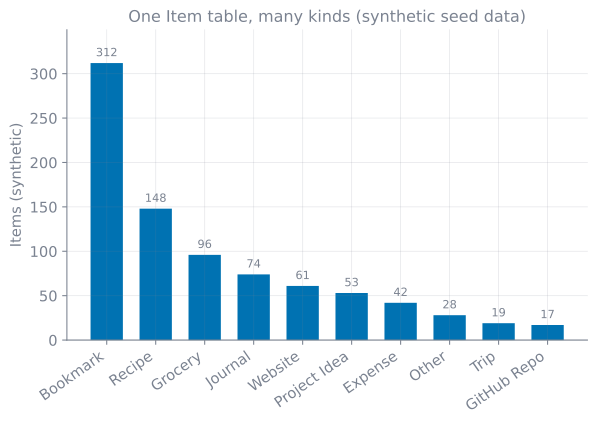
That whole distribution is one Item table. A timeline query is Item.objects.filter(owner=me).order_by("-created_at"); a filtered view is the same query with .filter(kind="RECIPE"). One endpoint, one index, every shape.
Composing nested serializers
On the API side, the base Item gets a straightforward ModelSerializer. The interesting work is in the extension serializers, because a recipe write isn’t one object: it’s a recipe plus its steps plus its ingredients, arriving in one nested payload. DRF lets you declare that nesting by embedding child serializers:
class RecipeSerializer(serializers.ModelSerializer):
    steps = RecipeStepSerializer(many=True, required=False)
    recipe_ingredients = RecipeIngredientSerializer(many=True, required=False)

    class Meta:
        model = Recipe
        fields = ("id", "item", "servings", "prep_time_min", "cook_time_min",
                  "source_url", "steps", "recipe_ingredients")
        read_only_fields = ("id",)
That declaration gives you nested reads for free: a GET returns the recipe with its steps and ingredients inlined. Nested writes are the catch, and it’s a deliberate one. DRF’s serializer docs are explicit: “the default ModelSerializer .create() and .update() methods do not include support for writable nested representations,” because “the behavior of nested creates and updates can be ambiguous, and may require complex dependencies between related models.” So DRF makes you “write these methods explicitly.” That’s not a limitation to route around. It’s the framework refusing to guess how a PUT to a recipe should reconcile the steps you sent against the steps already in the database. You’re the one who knows — the same reason a plan meant for a model to execute has to spell out the merge instead of trusting it to infer one, an idea I came back to in writing plans a model can actually execute.
Writing across tables atomically
So we write create() and update() by hand. A single recipe write touches three tables (Recipe, RecipeStep, RecipeIngredient), and the cardinal rule is that it must be all or nothing. If the recipe and four steps insert fine but the fifth step violates the unique_together("recipe", "order") constraint, you must not be left with a half-written recipe. That’s what transaction.atomic is for: as the Django docs put it, it “allows us to create a block of code within which the atomicity on the database is guaranteed. If the block of code is successfully completed, the changes are committed to the database. If there is an exception, the changes are rolled back.”
@transaction.atomic
def create(self, validated_data):
    steps_data = validated_data.pop("steps", [])
    ingredients_data = validated_data.pop("recipe_ingredients", [])
    recipe = Recipe.objects.create(**validated_data)
    for step in steps_data:
        RecipeStep.objects.create(recipe=recipe, **step)
    for ri in ingredients_data:
        RecipeIngredient.objects.create(recipe=recipe, **ri)
    return recipe
Pop the nested lists off the validated data first (they’re not columns on Recipe), create the parent, then create the children pointing at it. The @transaction.atomic decorator wraps the whole method in one transaction: any exception anywhere inside (a constraint violation, a bad foreign key) rolls back every insert, including the parent. You either get a complete recipe or none of it.
Updates need one more decision, because a PUT that includes steps is replacing the step list, not appending to it. The simplest correct approach is replace-in-place, still inside one transaction:
@transaction.atomic
def update(self, instance, validated_data):
    steps_data = validated_data.pop("steps", None)
    ingredients_data = validated_data.pop("recipe_ingredients", None)
    instance = super().update(instance, validated_data)
    if steps_data is not None:
        instance.steps.all().delete()
        for step in steps_data:
            RecipeStep.objects.create(recipe=instance, **step)
    if ingredients_data is not None:
        instance.recipe_ingredients.all().delete()
        for ri in ingredients_data:
            RecipeIngredient.objects.create(recipe=instance, **ri)
    return instance
The is not None check matters: a payload that omits steps leaves the existing steps untouched, while a payload that sends steps: [] clears them. Delete-then-recreate is blunt but honest, and because it’s atomic, a failure mid-rewrite rolls the old steps back into existence rather than leaving you with nothing. (If step identity or churn ever matters, say you’re diffing to preserve row IDs, you’d reconcile by key instead of nuking the set; but for a recipe’s handful of steps, replace-in-place is the right amount of code.)
The same pattern generalizes to every nested shape: a grocery list and its entries use the identical atomic create/update. Write it once per extension, and the polymorphic surface stays uniform.
Killing the N+1 (plot)
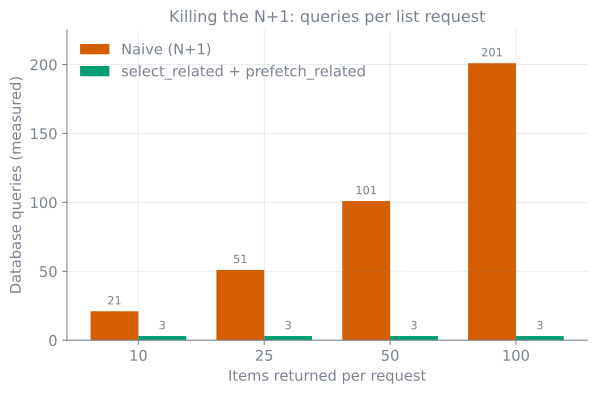
Now the part that separates a demo from production. The timeline endpoint returns a page of items, and each item has tags and attachments. The obvious queryset (Item.objects.filter(owner=me)) triggers the N+1 problem in its textbook form: one query to fetch the page of items, then, as the serializer renders each row, another query for that row’s tags and another for its attachments. A page of 50 items can fire over a hundred queries. The endpoint feels fine with ten rows in development and falls over under a real vault.
Django’s fix is eager loading, and it comes in two flavors documented in the QuerySet API reference. select_related “follows” single-valued relationships (ForeignKey and OneToOneField) by building a SQL JOIN and pulling the related fields in the same query. prefetch_related handles the many-valued ones (many-to-many and reverse foreign keys) by doing “a separate lookup for each relationship, and [doing] the ‘joining’ in Python.” So you reach for select_related on the owner foreign key, and prefetch_related on the tags (many-to-many) and attachments (reverse FK):
class ItemViewSet(ModelViewSet):
    serializer_class = ItemSerializer
    permission_classes = (IsAuthenticated,)

    def get_queryset(self):
        return (
            Item.objects.filter(owner=self.request.user)
            .select_related("owner")
            .prefetch_related("tags", "attachments")
        )
That single change turns “one query per row per relationship” into a small, constant number of queries: one for the page (owner folded into the join), one to prefetch all the tags, one for all the attachments. That holds no matter how many rows come back. The recipe viewset does the same one level deeper: select_related("item") for the one-to-one base, prefetch_related("steps", "recipe_ingredients__ingredient") to pull steps, ingredients, and each ingredient’s name in batches rather than per row.
Here’s the shape of it, naive versus eager-loaded, as the page grows:
The naive bars climb with the page size; the eager-loaded bars are a flat line. That flatness is the whole point: query count decoupled from result-set size is the difference between an endpoint that scales and one that quietly melts as the vault fills up.
Where I used this
I built exactly this in a personal-registry app: a polymorphic Item base, one-to-one extensions for the shapes that need them (Recipe with its steps and ingredients, grocery lists with entries), nested serializers with hand-written atomic create/update, and eager-loaded querysets on every list endpoint. The payoff is that the entire vault lives behind one coherent REST surface (one place for tags, search, favorites, and a unified timeline) while each shape still gets real columns and real constraints.
The lesson that travels past this particular app: heterogeneous data doesn’t force you into either a sprawl of endpoints or a structureless EAV blob. A shared base plus typed extensions gives you one surface and integrity. The two things you cannot skip are wrapping multi-table writes in transaction.atomic so a half-written object is impossible, and eager-loading your relationships so the read path doesn’t degrade into an N+1 storm. That same demand for correctness under partial failure shows up on the scheduling side too, just against duplicate executions instead of a crashed transaction — see idempotent monthly resets with Celery Beat. Get those two right, and the polymorphic model is a genuine pleasure to work with.
References and further reading
- DRF: Serializers (Writable nested representations): why
ModelSerializerwon’t auto-handle nested writes, and that you must writecreate()/update()yourself. - Django: Database transactions:
transaction.atomicand its all-or-nothing commit/rollback guarantee. - Django: QuerySet API reference:
select_related(SQL join, single-valued relations) vsprefetch_related(separate batched lookups, many-valued relations). - Django: The contenttypes framework:
GenericForeignKeyand generic relations, and their query/indexing caveats. - Django: Enumeration types (
TextChoices): declaring thekindenum in code. - B. Karwin, SQL Antipatterns: Avoiding the Pitfalls of Database Programming, Pragmatic Bookshelf (2010): the Entity-Attribute-Value pattern as a logical-design anti-pattern.
Working on something in this space, or hiring for it?
Keep reading
- An API-first vault my agents can call: designing a DRF backend for MCP-style consumersI built a vault so a skill or an agent could store structured items without me rewriting the domain each time. That meant designing the DRF API for a non-human caller: stable UUIDs, an open metadata field, and a discoverable OpenAPI schema. Then I probed it for idempotency and found I never built any.August 18, 2026
- Typed domain exceptions with stable error codes: the kernel raises a code, the adapter writes the proseAn accounting kernel that must never say a word to a user. Every domain failure gets a typed exception and a stable machine code; one adapter table turns that code into localized prose. Here's the hierarchy, the import cycle it caused, the contract check that reported green through a hole, and the bug I found writing this.August 11, 2026
- Finding the N+1 before it finds prod: the benchmark that couldn't failI wrote a benchmark to prove my vault API's eager loading worked, charted it, and published it. Five weeks later I deleted the eager loading from the viewset to watch the benchmark go red. Fifteen tests passed in 4.67 seconds and the benchmark cheerfully printed the same flat line.August 13, 2026
Get the next update by email
Build-in-public updates and new posts, delivered as a digest. Double opt-in · no spam · unsubscribe anytime · handled by Buttondown.